
This is a free fortnightly newsletter about the New Zealand Net.
If you would like to be notified by email when a new edition is published, subscribe here.
Browse our Newsletter Archive and List of Net Tips.
Featured key
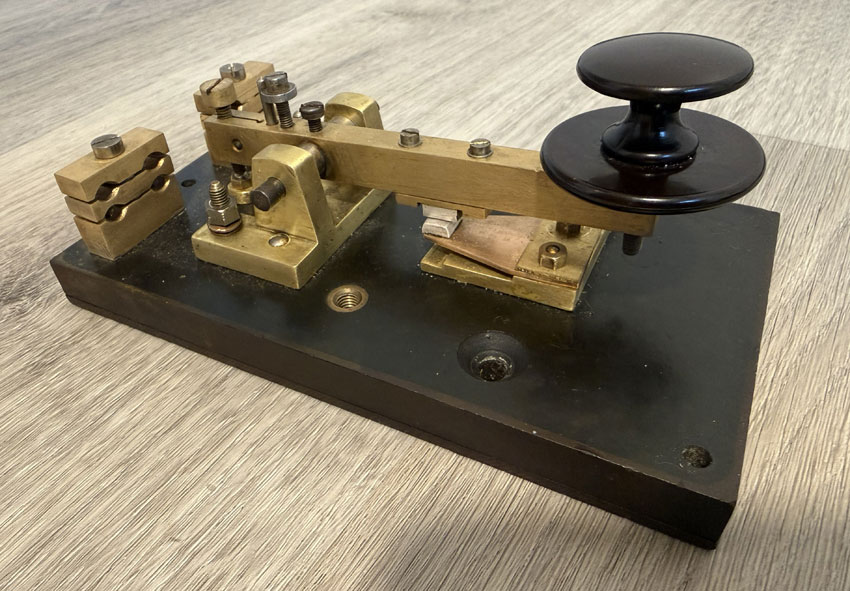
Photos: ZL4RY
By Ryan ZL4RY
Back in May, I was looking for my very first Morse key. I’d never actually seen one in person before, but I watched countless online videos and imagined what they would feel like beneath my fist.
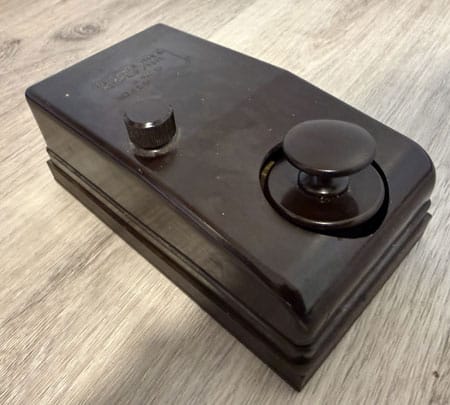 And then I saw a post on Facebook Marketplace: “Box lot, Morse key, old meter, etc.” It was, as you can probably imagine, a box of (mostly) junk. But there, amongst the rubbish was a CW key.
$20 later, it was on its way to Wānaka.
It was larger, heavier, and much nicer than I’d expected — but it felt exactly the way I’d imagined a real key to feel. And to make things even better, when I twisted copper wires and paper clips to the ends of a cannibalized 3.5mm aux cable … it worked!
Much to my surprise, and delight, when I looked up the model number – Type D 10F/7373 – I discovered that it was a key with a rich history in the British Air Ministry (RAF).
» Read more about the heavy-duty Type D ground station key.
Quick notes
 Winter Sprint results: I never really thought of ham radio contesting as a spectator sport – but it’s been exciting to watch the leaderboard in the winter ZL Sprints, which took place over four Tuesdays in August. The race for first place in the CW division was a battle between Grant ZL2GD and Bede ZL4KX, and only two points separated them at the final whistle.
Top CW scores:
1st: Grant ZL2GD – 76 points
2nd: Bede ZL4KX – 74 points
3rd: Bill ZL3VZ – 73 points
4th: Graeme ZL1BDS & Tony ZL2F – 63 points
» See full results
The International CW Council met on 17 August, and NZ Net was represented by Neil ZL1NZ. Most of the discussion dealt with ideas for encouraging more radio amateurs to get into CW, and ways for the various ICWC member organisations to work together. Getting people from all over the world on a single call was a challenge. Although the meeting was held at a very comfortable 9am here in NZ, it was late evening for the Europeans and early morning in Japan where at least one of our colleagues was facing a 2-hour train ride to work as soon as the meeting ended.
Underground radio. Learn how radios work in caves.
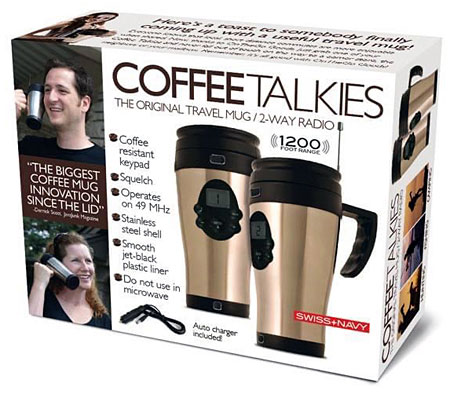
The photo? Unfortunately the Coffee-Talkie never really took off, due to an unfortunate oversight by its designer. That’s right, no Morse key! (Plus, of course, it’s a joke.)
Photo flashback
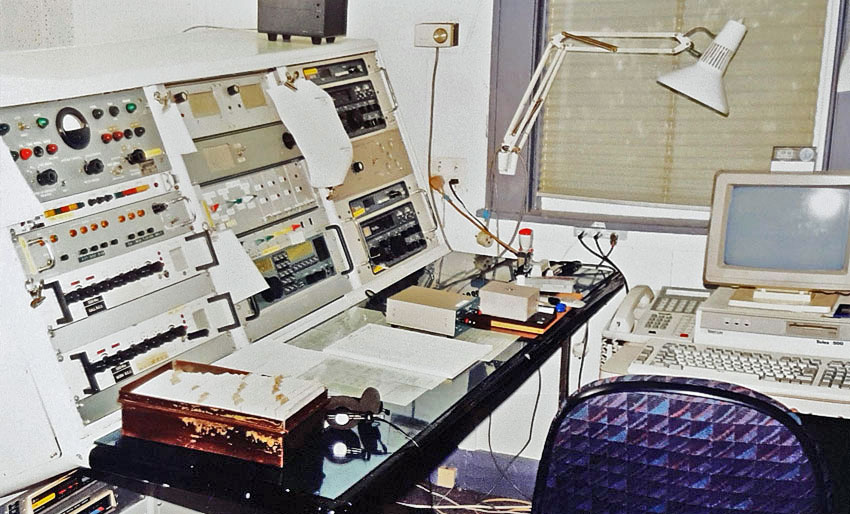
Photo: Graham Turner, maritimeradio.org
The photo shows the Morse desk at Wellington Radio ZLW, shortly before the station closed in 1993. This desk controlled MF (500 kHz) transmitters at the ZLW site (control panel for the 1kW Dansk transmitter is at top left) as well as HF (4/6/8/12/16/22 MHz) transmitters at Himatangi. Although there are several receivers in the photo, they were only used as backups, since the main receivers were located at Makara.
New callsign on the net
Ryan ZL4RY made his first check-in on 20 August, just two days after getting his amateur radio licence! Ryan may have set some kind of record for the most rapid progress in amateur radio, and his CW story, which starts below, is truly inspiring.
Ryan was born and raised on a dairy farm in Ohio, USA. After working as an accountant until age 25, he set off on a six-year adventure as a tour guide in Alaska. Eventually his wanderlust brought him to Wānaka in 2016, where he quickly met his future wife. As he says: “I’ve been happily stuck here ever since.”
“Really doing it!”
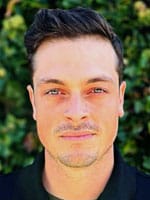 By Ryan ZL4RY
Hello, I’m ZL4RY.
But 100 days ago, I didn’t even know amateur radio existed. I’d never even heard of it.
I knew that truckers in the United States (where I’m from originally) used CB radios. I knew that fishermen in Alaska (where I was before NZ) used marine VHF. I knew that kids playing in the woods used walkie-talkies. And that was about the extent of my knowledge of radio.
A hundred days ago, my brother sent me a link to a webpage about cryptic numbers stations – the strange broadcasts used to send coded messages during the Cold War. The site included links where you could actually listen to some of these stations.
Out of curiosity, I clicked one. It took me to a WebSDR but, at the time, I had absolutely no idea what a WebSDR was.
I was entirely confused. Static. Noise. Signals that meant nothing to me. Numbers and buttons and abbreviations everywhere. I almost clicked the X at the top of the browser.
But for some reason, which I really can’t explain, I didn’t. Instead, I spent most of that afternoon using ChatGPT to slowly figure out what I was looking at.
The first revelation was that there were different modes. On AM, I found shortwave broadcast stations from around the world. On LSB and USB, I found people having conversations.
And then I found my first CW signal.
I couldn’t tell you what band it was on. I couldn’t tell you where in the world it came from. But it was Morse code, and I was fascinated.
I had absolutely no idea what they were saying. But I knew that I wanted to. So, in that moment, I decided that I was going to learn Morse code.
I spent the next 48 hours researching the best ways to learn it. Somewhere in that search I kept encountering another term: “Amateur Radio.” That was the first time I had ever heard those words. And suddenly this whole new frontier opened up in front of me.
From that point on, I had two goals: I needed to become a ham, and I needed to learn Morse code – which, I now understood, the cool kids were calling “CW.”
I decided to concentrate on the CW first. I figured that if I practiced Morse code every day for a couple of months, and wasn’t sick of it, then I would worry about actually getting on the air.

I discovered LCWO.net pretty quickly. It starts newcomers with Koch-method lessons to learn the characters, then moves into random five-character groups at increasing speeds to build proficiency. I trained for probably 90 minutes a day, every day, and I kept a log of everything: speed, Farnsworth spacing, word spacing, errors and test results. Every session went into the notebook.
At first, it seemed impossible. But that was part of the attraction.
I practised and drilled until I was hearing Morse Code in the hum of the heat pump and the squeaky belt on my clothes dryer. I used ChatGPT to build little CW training programs to improve my instant character recognition – and, surprisingly, they worked.
I ordered an adapter that would allow me to connect a Morse key to my laptop and practise sending on VBand. But there was a major problem: I didn’t have a key.
So while I waited for Ali Express to make its way from China, I started building keys from thrift store parts. Straight keys and cooties from a music stand, paddles from hacksaw blades and metal Kebab skewers.
I didn’t have a soldering gun – and didn’t even know how to use one, so tight wraps of wire and superglue held my new toys together faithfully (and still do).
I didn’t really know what I was doing, but I was having a lot of fun doing it. And eventually I scored a legitimate Morse key for $20 on Facebook Marketplace (RAF Type D. 10F/7373).
According to my training log, it took exactly 74 days from my first Koch Lesson until I was copying 20 wpm five-character groups above 95% regularly. No Farnsworth, no extra word spacing.
I was really doing it.
In the next NZ Net News: Ryan describes getting his licence and getting on the air.
Top9 activity
 By Martin DL1GBZ, ICWC
The International CW Council (ICWC) runs the successful MST contest, so why do we need an “activity”? The answer is straightforward. We are all different, and our preferences are different, and some of us are not active in contesting. Therefore ICWC wants all operators to be included and have fun.
In Top9 any 5-minute minimum contact is OK at any time. To initiate one, you may find CQ callers by scanning the Reverse Beacon Network, you may invite a friend by phone, or you may just call CQ the old-fashioned way to name a few ways.
What counts is your presence. With your active participation, you are showing your love of CW and that you support the efforts of ICWC and its member clubs to keep CW alive. By using the top 9 kHz of each CW band, we will have a better chance to preserve them by showing activity there.
If you invest some time in Top9, you will certainly make new friends and will have quality CW contacts.
Rules
Frequencies: Top 9 kHz of the CW-only bands (as defined by IARU)
Stations to contact: All
Mode: CW-CW
Scoring: QSO duration less than 5 min: 0 points. QSO duration minimum 5 min: 1 point then 1 point for every additional 5 minutes. Example: a 15 minute QSO counts for 3 points and a 19 minute QSO still counts only for 3 points.
Participants declare their monthly scores (i.e. QSO numbers) on the ICWC website.
Top9 homepage
Top9 score submission page
Top9 results page
Where can I make contacts?
A good place to look for contacts of five minutes duration or longer is in the top 9 kHz of the CW-only sub-bands in each IARU region. Remember that these are not the same as the New Zealand or Australian CW-only sub-bands (which, also, differ from each other). Fortunately, CW is permitted on most amateur frequencies, including outside the CW-only sub-bands. If in doubt, consult your local regulations and band plans before transmitting.
– Ed
The Ham Band
(with apologies to any music lovers)
Net tip: QSB
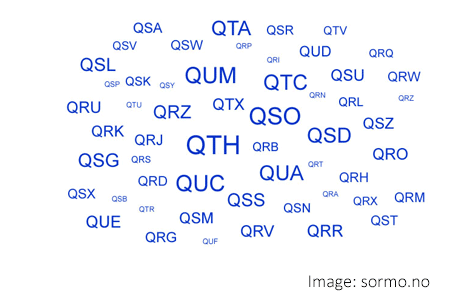
We continue our look at Q signals with QSB, one of the simpler and better-known Q Signals.
As a question, QSB? means: “Are my signals fading?”
As a reply, or a statement, QSB means: “Your signals are fading.”
QSB is one of those Q Signals whose meaning has changed. A hundred years ago, it referred to the tone of a transmitter. You can see this on a 1926 QSL card from Z3AI at Rangiora High School in NZ Net News 40.
The A-Z of Q Signals
A well-run CW net is a lovely thing to experience. Communication between stations is quick and concise, and the net business is conducted with minimal time wasted.
As CW operators, we have many techniques to communicate quickly and efficiently. And if we know and use these techniques, we can often match or exceed the speed and accuracy of voice communication.
One of our most important tools is the set of Q Signals (or Q Codes), and in this series we look at the “essential” ones, in alphabetical order.
Morse challenge
Send your answer via radiogram (or email if no propagation) to ZL1NZ.
The answers to our previous Morse Challenge (the mystery lighthouse) are: Portland Island (Waikawa), callsign ZLOE, now located in downtown Wairoa. Correct answers were received from ZL1ANY, ZL1AYN and ZL3TK.
Advertising archive
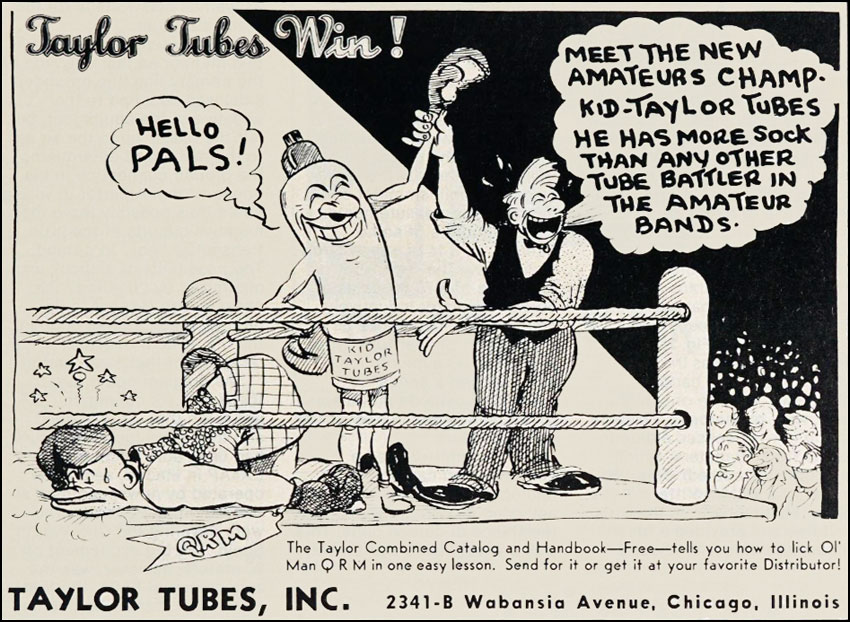
Advertising cartoon by the legendary Otto Eppers W2EA in the 1930s
NZ Net tally board
Suggestions?
If you have suggestions on how to make the NZ Net better, or things you’d like to see covered in these newsletters, please contact ZL1NZ. Articles and photos will be gratefully received!
Thanks for reading, and I hope to hear you soon on the NZ Net!
—
Neil Sanderson ZL1NZ, Net Manager
New Zealand Net (NZ NET)
 Open the menu by clicking the “burger” icon at top right.
 Many menu items can be expanded to reveal subpages by clicking on the arrow. Click again to collapse the menu item.