
This is a free fortnightly newsletter about the New Zealand Net.
If you would like to be notified by email when a new edition is published, subscribe here.
Browse our Newsletter Archive and List of Net Tips.
Featured key

Photo: ZL1SZN
This Vibroplex-inspired bug was made by a machinist in Lunenberg, Nova Scotia – probably about 100 years ago. It is on display in the Fisheries Museum of the Atlantic, at Lunenberg, where staff believe it was used aboard one of the city’s famous “bottle-fishing” ships.
What’s bottle fishing? Also known as rum running, it was smuggling of liquor from Canada to the USA during the Prohibition era of the 1920s and 1930s.
The Canadian rum runners had fast ships, originally schooners and later motorboats with huge engines. They carried wireless operators who exchanged coded messages with the local US boats that picked up the booze just outside the US 12-mile limit off New York City.
See the video below for more on the bottle-fishing fleet.
Quick notes
 Straight Key Night on 7 June drew at least 19 participants, including three from Australia, plus several SWLs. Congratulations to NZ Netters ZL1AJY and ZL2GD who shared the Bruce Scahill Best Fist Award as decided by popular vote. See the full report, where you can check how well you copied the exchange from each station.
Our Null Island story in NZ Net News 186 got me thinking about another interesting spot on the Earth’s surface: the place in the Pacific Ocean where the International Date Line crosses the Equator. Legend has it that this spot was visited in 1899 by SS Warrimoo, at which time the ship was simultaneously in 4 hemispheres, 2 seasons, 2 dates and 2 centuries. But, did it really happen? Read more.
And if you are really into latitude and longitude (and great circle routes, antipodes, etc.) then you might enjoy this new online tool. At the moment, it works on desktop computers only.
The NZART Memorial Contest is in two weeks, on Saturday 4 July. This event takes place on 80 metres CW and SSB. As with the recent Sangster Shield QRP contest, the Memorial Contest has been scaled back this year to take place on one evening only, in hopes of encouraging more participants. Note that logs must be submitted in electronic form, preferably Cabrillo. Get details.
Winter Solstice is this Sunday, 21 Jun, always a great excuse for getting on the air and checking the low-band propagation.
Photo flashback

Manny Diaz, M/V Astros A8OH, 1979. Maritime Radio Group on Facebook
Photos needed: If you have a good-quality photo of an old New Zealand amateur radio station (maybe even your own?) please send it along for this feature. Or photos of any amateur radio activities, ideally with people included. The email address for ZL1NZ can be found on qrz.com.
Solid copy

“Here’s a certificate from when I did a Morse run at a RSGB exhibition back in 1969, seems like forever ago. The odd thing was that the tape had an error in it. I was there with another trainee R/O and we both copied it exactly as, and both got the same “error” so we demanded a rerun at a slower speed so that it was definitely double checked.”
– Gavin ZL1BBW
When learning Morse, we are told to copy exactly what is sent – not what we think should have been sent. I have heard of Morse examiners including deliberate errors in their sending, as a trap. They wouldn’t have fooled Gavin! 🙂
– Ed.
Message forms

A couple of things I have noticed recently on NZ Net when traffic is being handled:
1. Elements of the preamble, or message header, are occasionally being omitted. The only optional element is the HX code (handling instructions).
2. Check numbers often don’t match what is sent. For example, a station might send a date within the body text as a single “word” such as 13MAY26, but count it as three words in the check numbers. The check numbers must correspond to what is actually sent.
One way to ensure your outgoing radiograms have all the necessary elements, and the correct check numbers, is to use the NZ Net message blanks, which are free to download.
Video: Rum runners of Nova Scotia
Further to our featured key, above, here’s a little background on the lucrative liquor smuggling from Canada to the USA during the 1920s and 1930s:
Net tip: QRV
We continue our look at Q signals with QRV.
As a question, QRV? means: “Are you ready?”
In most cases, the implied meaning is “Are you ready to copy my traffic?”
As a reply, or a direction, QRV means: “I am ready.”
In practice, we often just reply with “C” (yes) or with a signal report so that the sending station can adjust their sending if required to make it easier to copy.
QRV is used a lot in traffic handling, but its meaning is quite general, so you may find other uses for it.
The A-Z of Q Signals
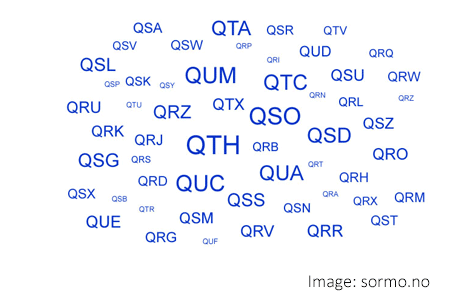
A well-run CW net is a lovely thing to experience. Communication between stations is quick and concise, and the net business is conducted with minimal time wasted.
As CW operators, we have many techniques to communicate quickly and efficiently. And if we know and use these techniques, we can often match or exceed the speed and accuracy of voice communication.
One of our most important tools is the set of Q Signals (or Q Codes), and in this series we look at the “essential” ones, in alphabetical order.
Morse challenge
Please send your answer via radiogram to ZL1NZ, or via email if no propagation.
Our previous challenge asked for the latitude and longitude of Null Island. The answer: 0 deg N, 0 deg E. Correct answers were received from PA9O, VK3DRQ, VK4KJJ, ZL1ANY, ZL1AYN and ZL1BBW.
Advertising archive

1992
Suggestions?
If you have suggestions on how to make the NZ Net better, or things you’d like to see covered in these newsletters, please contact ZL1NZ. Articles and photos will be gratefully received!
Thanks for reading, and I hope to hear you soon on the NZ Net!
—
Neil Sanderson ZL1NZ, Net Manager
New Zealand Net (NZ NET)


 Open the menu by clicking the “burger” icon at top right.
 Many menu items can be expanded to reveal subpages by clicking on the arrow. Click again to collapse the menu item.