
This is a free fortnightly newsletter about the New Zealand Net.
If you would like to be notified by email when a new edition is published, subscribe here.
Browse our Newsletter Archive and List of Net Tips.
Featured key
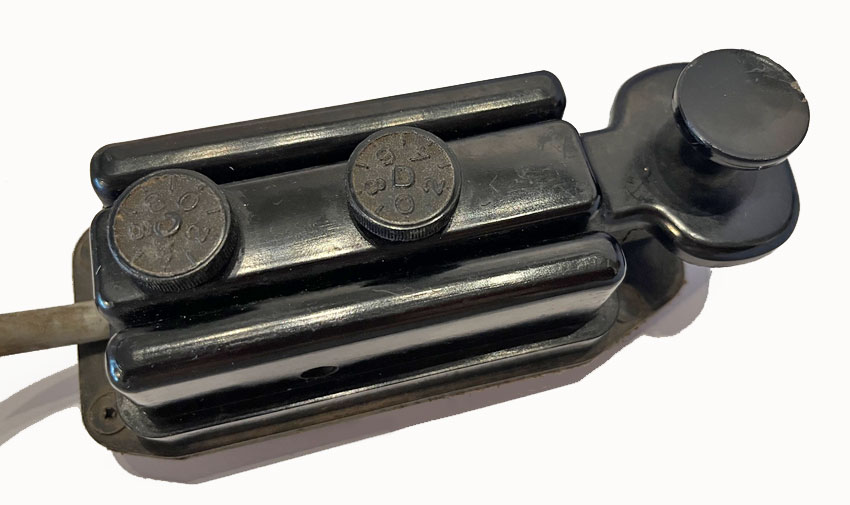
Photo: ZL3CK, Musick Point Radio Group
Here is a Manitone key, model 29418, from the French company Dyna. (Manitone appears to have been the name used for the firm’s straight keys.)
This one belonged to the late Paul Young, who was an operator at Auckland Radio ZLD. His family donated it to the Musick Point Radio Group and it is on display among other Morse keys in the museum at Musick Point.
“A. Chabot was Dyna’s founder. He began his career working for Georges Pericaud, the famous wireless manufacturer in 1909, where he designed the first crystal set for them. After WW1, Chabot became president of Pericaud. In 1921 he founded “A. Chabot” with trademark Dyna. The company produced various radio equipment for both amateurs and professionals.”
– Herman VK2IXV
“The type 29414T was the last key produced by Dyna, marketed around 1954 and still for sale in the 1980s. There were several versions, with or without cover, simple or double circuits, etc. Another version (29416T) was used in the Caravelle jetliner, and another model (29417T/29418T) with interference filters was used by the French Navy. Dyna ceased operations in 1989.”
– Thomas OH6NT
Quick notes
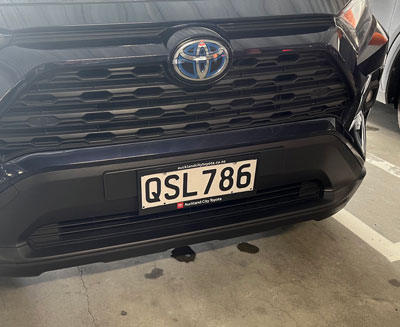
Photo: ZL3CK (official Q-Signal spotter)
Award winners: The CW Ops group has announced its annual Award for Advancing the Art of CW. This year’s winners are: Mark Bosma VK2KI, Fabian Kurz DJ5CW and Martin Kratoska OK1RR. See details.
The NZART Memorial Contest is Saturday 4 July on 80 metres CW and SSB. It has been scaled back this year to take place on one evening only, in hopes of encouraging more participants. Note that logs must be submitted in electronic form, preferably Cabrillo.
One shack, six hams. Dave ZL4LDY reports he had a full shack on Thursday 2 July: “There were six of us – Alen ZL4MD, Allan ZL4QC, Greg ZL4GW, Bede ZL4KX, Charley ZL1VR and me. My HF antenna received significant attention, cleaning up some weather corrosion. Some more work will be required at a later date, but I can’t predict when that can happen. A VHF antenna was installed, and worked very well. I was pleased to get my TR7930 connected. My HF noise was intermittent and everyone agrees it is something local, but no one knows precisely what it is, because there are more possibilities than anyone could guess! The working bee took 3 hours in daylight, under great weather.”
The 10th World Radio Sport Team Championship will be held in the United Kingdom 8-13 July. Every four years the WRTC relocates to a new host nation. WRTC provides a platform for high-achieving radio contesters to compete on a level playing field — in the same geographic region, using identical antennas, output power and other operating conditions. Each team has had to qualify through HF radio contests from October 2023 to March 2025. Now, 100 operators are heading to the UK from all over the world and will represent their home countries. Each team of two will draw their operating site, their referee and callsign — and then they will go off and operate the 24-hour IARU 2026 Contest. Live scoreboards will be available.
Photo flashback
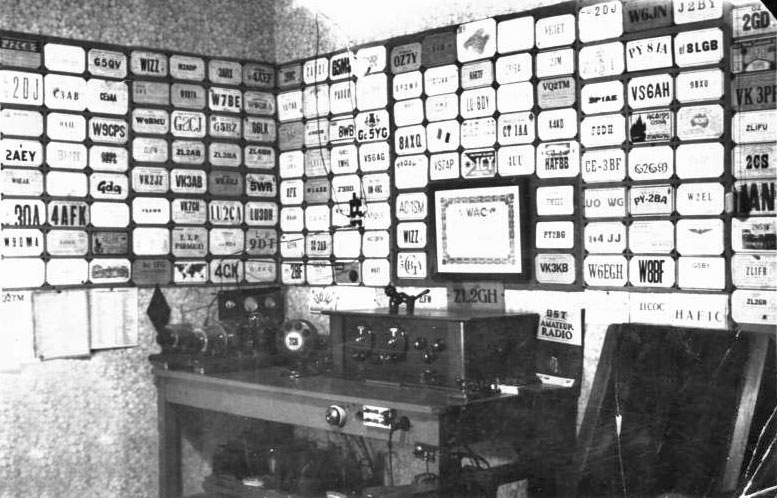
The very tidy station of Norm Hopper ZL2GH in 1930. Note the QST magazine on the desk and, at top right, a QSL card from 2GD (but it’s not from our friend Grant – it’s actually from OZ2GD). Photo courtesy Whanganui Amateur Radio Society
Net numbers
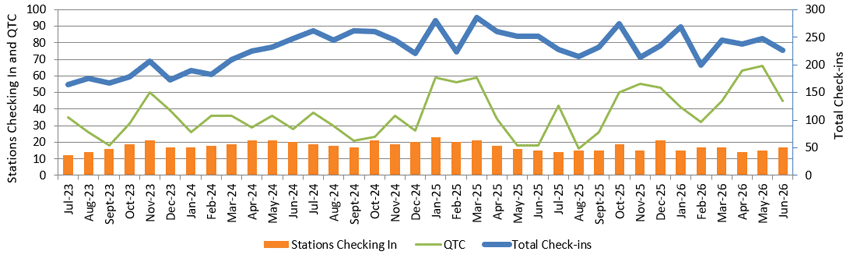
NR24 R ZL1NZ 43/40 AUCKLAND 0900Z 1JUL26
=
NZ NET
=
JUN QNI KD6XU/MM 2 VK3DRQ 23 VK4PN 10 ZL1AJY 3
ZL1ANY 29 ZL1BDS 20 ZL1NZ 30 ZL1PX 28 ZL2GD 9
ZL2KE 7 ZL2LN 18 ZL2TE 7 ZL3TK 1 ZL4FZ 13
ZL4GW 20 ZL4KX 5 ZL4LDY 2 TOTAL 227 QTC 45
=
ZL1NZ
KD6XU/MM checks in
By Stephen ZL1ANY
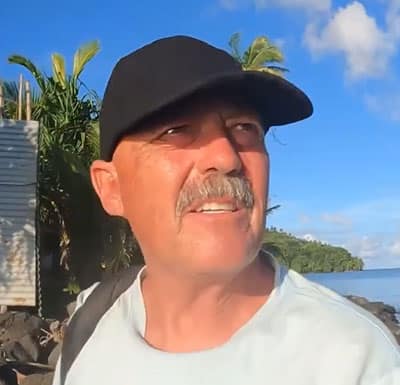 Barry Palmatier KD6XU is a bluewater sailor from California, who has checked into the NZ Net during his recent passage from New Zealand to Fiji.
Barry, who is a retired electrical engineer, operates an IC-7300 transceiver aboard his sailboat, Ma Kai, which has carried him across some of the most remote stretches of the Pacific Ocean. He has been active from multiple locations in French Polynesia, including Nuka Hiva and Fatu Hiva in the Marquesas Islands, operating CW mainly on the 40–12 metre bands.
His Pacific voyages have taken him to some genuinely rare DXCC entities including (as 5W0BP) Apia, Samoa; and (as FW/KD6XU) Uvea, Wallis Island.
He documents his adventures through YouTube, sharing his life aboard Ma Kai with fellow sailing and ham radio enthusiasts alike.
I first worked Barry using JS8 some years ago when he was setting out from the west coast of Mexico to travel across the Pacific to NZ. My station power was only about 10 watts. Barry beacons APRS IS with maidenhead position locators over JS8 and this is picked up by gateways and forwarded to aprs.fi to allow tracking. He is also active on Winlink and can be tracked at predictwind.com. His uncle, who normally works QRO, has a QDX into a fan dipole operating at 5 watts for JS8 comms with him.
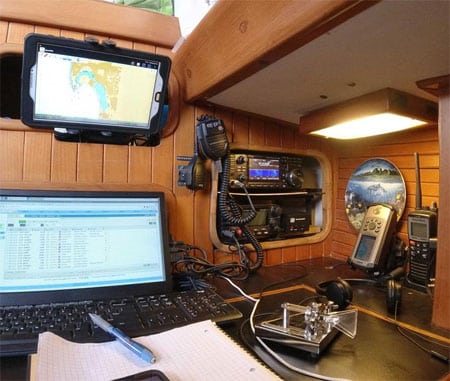 About 18 months ago I worked Barry again in Northland from his boat in the Whangarei marina, also using JS8.
In the last month I have had further contacts with him using JS8 and CW as he worked his way up to Fiji where he will be spending some time before probably coming back to NZ. The other night after NZNET we had a cw contact on 3535 whilst he was south of Fiji in strong southerly weather. He was using a Begali paddle in his lap due to boat motion and is to be congratulated for the quality of his sending considering the conditions.
We may hear him on NZ Net from Fiji where he will be using the callsign 3D2BP.
An intriguing QSL card
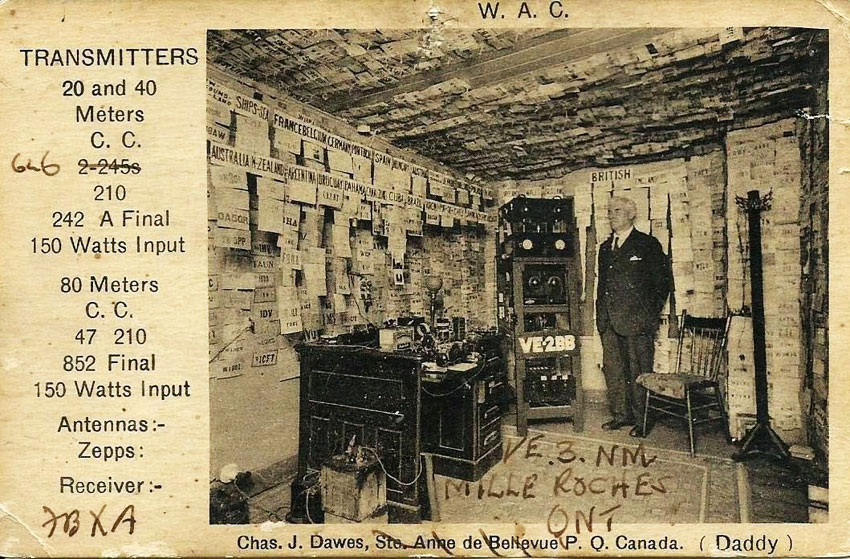
This old QSL card appeals to me for a few reasons:
1. It’s a QSL card that shows an impressive display of QSL cards! Notice how neatly organised they are, under headings such as “Australia – N Zealand” and “Ships at Sea”. There are so many cards, they continue across the ceiling too. I wonder what kind of glue was used!
2. The card was printed when Charles Dawes held the callsign VE2BB in Sainte Anne de Bellevue, Quebec. But it appears that by the time this card went into the mail, Charles had moved to Mille Roches, Ontario, where he would have been required to change his callsign to a VE3, in his case VE3NM.
3. QSL cards from Mille Roches are quite rare, and here’s why.
Video: BBC closes long-wave transmission
At 1am British time on 27 June, the BBC ceased broadcasting from its long-wave transmitters at Droitwich. which are now considered obsolete.
The transmitters, on 198 kHz, had been used most recently to carry BBC Radio 4, including the much-loved Shipping Forecast. For the moment, the are transmitting a looped message advising listeners to access Radio 4 on other frequencies or online.
Net tip: QRX
We continue our look at Q signals with QRX.
As a question, QRX? means: “When will you call me again?”
As a reply, or a direction, QRX x means: “I will call you again at … hours (on … kHz/MHz).”
In other words, QRX is always followed by a number x which is the time, and may include a second number which is the frequency. For example:
- QRX 0230Z
- QRX 0230Z 7030 kHz
In practice, we sometimes specify an interval rather than a time, such as QRX 10 mins, meaning “I will call you in 10 minutes.”
The A-Z of Q Signals
A well-run CW net is a lovely thing to experience. Communication between stations is quick and concise, and the net business is conducted with minimal time wasted.
As CW operators, we have many techniques to communicate quickly and efficiently. And if we know and use these techniques, we can often match or exceed the speed and accuracy of voice communication.
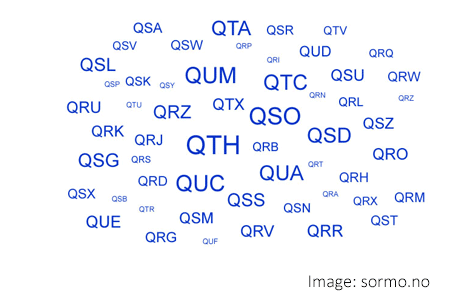
One of our most important tools is the set of Q Signals (or Q Codes), and in this series we look at the “essential” ones, in alphabetical order.
Morse challenge
Please send your answer via radiogram to ZL1NZ, or via email if no propagation.
Our previous Morse Challenge question asked you to name the countries represented by the following amateur radio prefixes: CL, E4 and EP. The answer is: Cuba, Palestine and Iran. Congratulations to ZL1AYN and ZL3TK, who sent the correct reply.
Source: ITU – Table of International Call Sign Series
Advertising archive
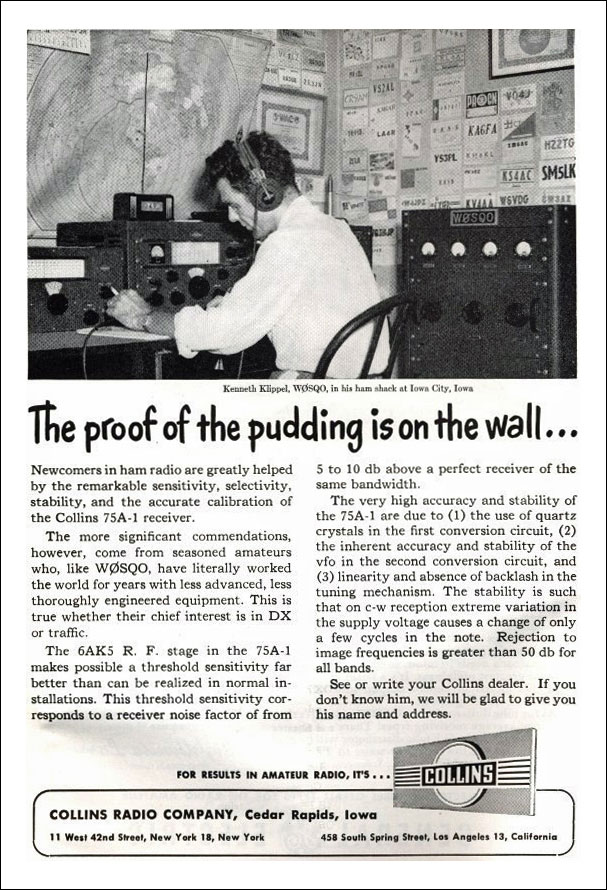
More QSLs in this advertisement from the 1950s
Suggestions?
If you have suggestions on how to make the NZ Net better, or things you’d like to see covered in these newsletters, please contact ZL1NZ. Articles and photos will be gratefully received!
Thanks for reading, and I hope to hear you soon on the NZ Net!
—
Neil Sanderson ZL1NZ, Net Manager
New Zealand Net (NZ NET)

 Open the menu by clicking the “burger” icon at top right.
 Many menu items can be expanded to reveal subpages by clicking on the arrow. Click again to collapse the menu item.