
This is a free fortnightly newsletter about the New Zealand Net.
If you would like to be notified by email when a new edition is published, subscribe here.
Browse our Newsletter Archive and List of Net Tips.
Featured key
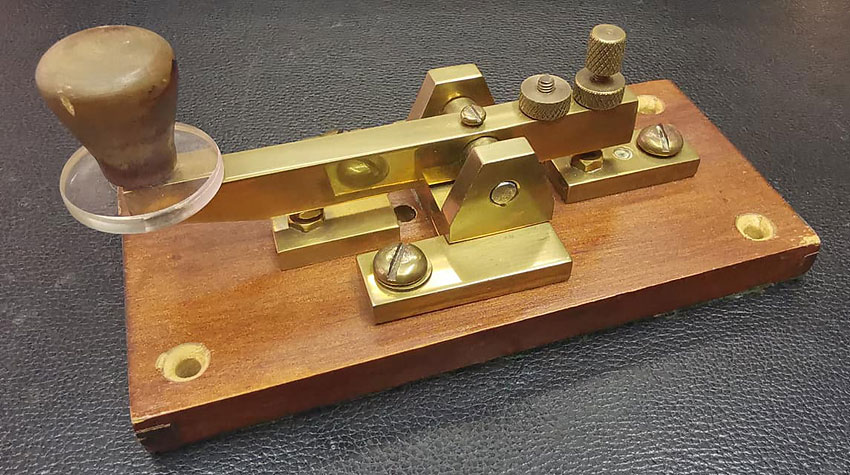
Photo: VR2GP
This is the rare third version of the famous Supreme key, sold by Tricity House in Christchurch.
Approximately 15 of these keys were made in the late 1980s by Paul Collins ZL3PTP.
“I was quite interested in Morse,” says Paul, “and wanted a key so I went to see Don (?) at Tricity House. He brought one out but told me that he would not sell it because it was badly made. From memory, it used rough brass castings that were poorly machined. He however offered to lend me the key so I could take measurements in order to make one for myself.
“Using that key and another standard British Post Office key, lent by a friend, I made what I thought was a good key – one that still sits on my bench.
“When I returned the Tricity House key to Don and showed him my homemade key, he asked me if I would make copies of my key for the shop. I felt obligated to agree and started making keys in batches of about 4 or 5 from then until the shop was sold and closed.”
» Read more at the NZ Morse Key Directory.
Quick notes
 Congratulations to Ryan ZL4RY who has completed his first 25 check-ins to the net, and is now a qualified NZ Net member. Sadly, Ryan won’t be following the net when we switch to 40 metres this Sunday, as he is still on his 3-month restricted licence for a few more weeks, but we look forward to hearing him on 7030 as soon as he is able to operate there.
Homemade QSL cards. Josh VE3YTX is another new ham, and he’s come up with a creative (and admittedly complicated) way of making QSL cards with a vintage look.
Straight Key Monday is the first Monday of every month on NZ Net. Some CW ops say their straight key fist is pretty rusty, so here’s an easy way to stay in practice. Just check-in using a straight key (but all types of key are welcome, of course).
Editor wanted. If you’re an NZ Net member and would like take over the production of our newsletter (starting any time between now and the end of this year) please contact ZL1NZ to discuss.
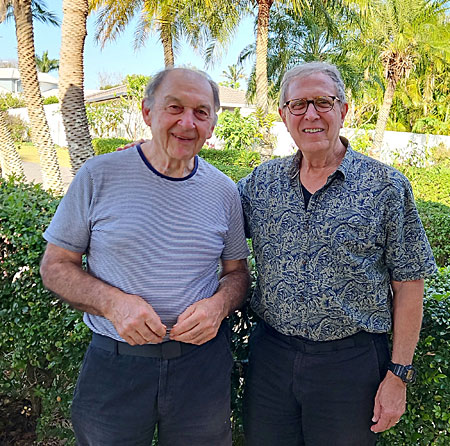
Pictured: Steve ZL2KE (right) visiting Sava VK4PN earlier this month.
Photo flashback
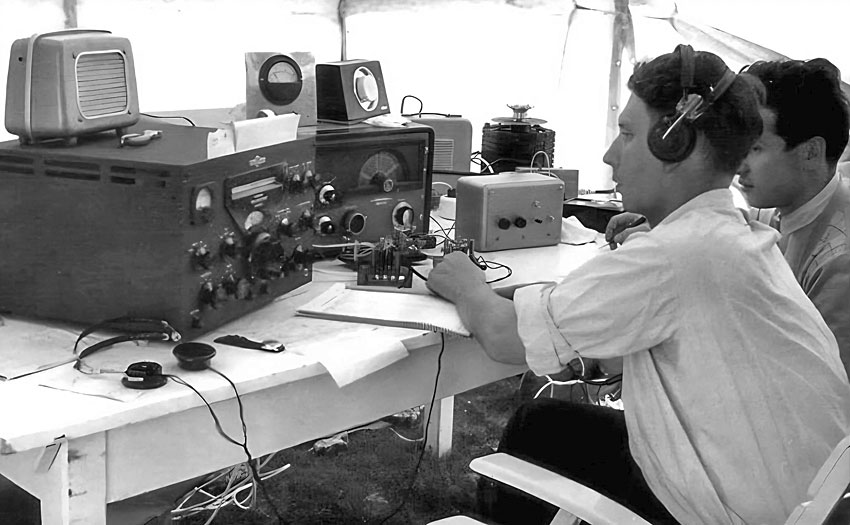
Field Day in Germany with a 75A-4 receiver and HT-32 transmitter, 1960
Net moves to 40
 This Sunday, New Zealand switches one hour forward to Daylight Saving Time. The NZ Net remains at 2100 hours local time, which will be 0800 UTC from Sunday.
The net frequency will also change, from 3535.0 kHz to 7030.0 kHz or higher, for the duration of the southern summer.
Operating on 40 metres is more challenging than operating on 80 metres, due to the band being a lot busier, including DX and contest activity, plus pirate operators (see NZ Net News 193 for one example).
If you hear other activity on 7030.0 at net time, or you hear nothing, please tune upwards. It may be that Net Control has heard other stations using 7030.0 and decided to shift the net up the band a bit.
We’ll try to stay as close to 7030.0 as possible, while still getting a clear frequency.
It will also help if all stations can please QNZ to the actual frequency on which Net Control is operating. Please tune very carefully, as we may not be on a “dot zero” frequency. For example, we might be on 7031.2. We need all stations to be on the same frequency, so if net control lets you know that you are QNL or QNH, please QNZ.
Net Control will also send a tuning call before the start of the net, typically 2 minutes before the start.
Morse at MOTAT
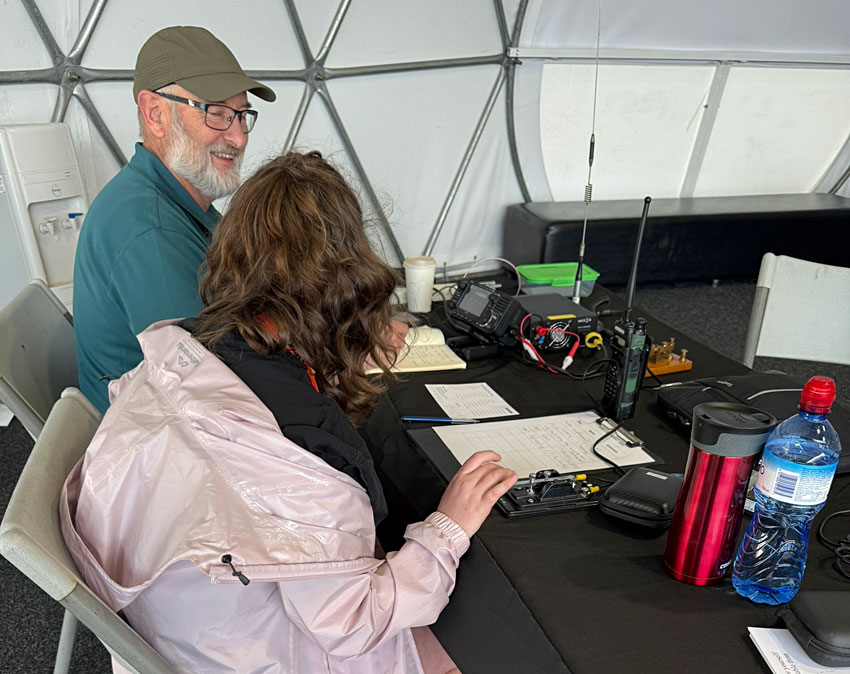
John ZL1KLF helps a young op send her name during the MOTAT Live Day
By Peter ZL1PX
On Sunday 20 September, Franklin Amateur Radio Club went to MOTAT in Auckland for a live CW demo. There were four helpers: Tom ZL1TO, Lynette ZL1LL, Deb ZL1DEB and Steve ZL1SPR plus two CW operators: John ZL1KLF and myself ZL1PX.
A ‘Live demo’ meant two 2-metre all-mode rigs in adjacent buildings. Steve brought along his ICOM-705 and I used my venerable ICOM-290C. Both rigs transmitted on mag-mount antennas and were about sixty metres apart. Reception was crystal clear.
As family groups drifted in, we asked: “Would you like to send your name in Morse code?” Most young visitors and some adults wanted to try. They wrote their name and translated this into Morse on a card. They practised their name on a sounder a few times. When they looked ready, the operator contacted the second station and the visitor keyed their name live on air. There were then some big grins as they recognised the letters of their name come back from the other station.
The day was overcast and windy so numbers were down on previous years but twenty would-be ops managed this exchange successfully. Spacing was a challenge. Young Lily sent the letter L as dot dash space dot dot, which made the op at the other end think he was in contact with ChatGpt or Copilot. He sent back question marks until Lily got it right. She was so delighted with her success she went to the second station and repeated the experience.
There’s a lot of satisfaction is seeing young folk enjoy themselves. Parents too expressed their gratitude freely. I can’t think of a more enjoyable way of promoting ham radio.
My thanks go to John, Tom, Lynette, Deb and Steve. It’s a big ask to travel 60km, set up equipment, smile all day and carry gear about – all to keep the ham radio fire going – but they did it in style.
Net tip: QSK
We continue our look at Q signals with QSK.
As a question, QSK? means “Can you hear me between your signals and, if so, can I break in on your transmission?”
As a reply, or a statement, QSK means “I can hear you between my signals; break in on my transmission.”
Or, to put it another way:
QSK? means “Shall we use full break-in?”
QSK can be sent by a station sending traffic, to indicate the receiving station is welcome to ask for a fill at any time. For example: NW QTC1 QSK <CT> etc.
You do not have to be using full break-in to take advantage of it while receiving. As long as the transmitting station has full break-in, you can interrupt them by simply send a couple of dahs (or a long dah if you are using a straight key), which will cause them to pause, and you can then ask for your fill.
Experienced CW operators, including DXers, contesters and traffic handlers, almost always use full break-in. If you haven’t tried it yet, give it a go!
The A-Z of Q Signals

A well-run CW net is a lovely thing to experience. Communication between stations is quick and concise, and the net business is conducted with minimal time wasted.
As CW operators, we have many techniques to communicate quickly and efficiently. And if we know and use these techniques, we can often match or exceed the speed and accuracy of voice communication.
One of our most important tools is the set of Q Signals (or Q Codes), and in this series we look at the “essential” ones, in alphabetical order.
Morse challenge
Send your answer via radiogram (or email if no propagation) to ZL1NZ.
Our previous Morse Challenge asked for the meanings of ZBM1 and ZBM2. Correct answers were received from OE1HFC, VK3DRQ, ZL1AYN, ZL1ANY and ZL3TK. Bob ZL1AYN was first-in with the correct answers, and he included an interesting story:
Both ‘Z’ codes are found in ACP 131 which we used in the Army back in “the Day.”
ZBM 1: place on watch on this frequency a qualified speed key operator.
ZBM 2: place on watch on this frequency a competent operator.In 1960 I was seconded from the British Army to serve as a Radio Technician in the Trucial Oman Scouts in Sharjah, now the UAE.
When I arrived, telephone circuits between Sharjah and Dubai did not exist, as landline cables were still to be laid. The upsurge in communication equipment to cater for a planned airport in Dubai and oil terminals in Abu Dhabi for Mega Fuel Tankers was yet to commence. In the Scouts our radio equipment was all WW2 vintage, such as 19 sets, C52 and a venerable 53 set on a link to Bahrain.
Due to lack of port facilities in Sharjah our heavy stores came by a landing craft operated by the Royal Navy and beach landed at Sharjah. Communications to these vessels were all in CW while in transit in the Persian Gulf.
One of our training tasks was instructing the Trucial Oman Scouts Army soldiers in communications skills. In our Sharjah communications centre (COMCEN) we had a number of young Arab boys under signals training, they were pretty good at morse considering each morse symbol received had to be written in English text.
A shipment of Dodge Power Wagons and heavy equipment arrived and was unloaded on Sharjah beach. The ship had experienced a few communication problems on the Bahrain to Sharjah leg with a bit of confusion between operators. While the landing draft was being unloaded the ship’s radio officer, a rather large bearded matelot, stormed into the COMCEN demanding to know who had dared to send a ZBM2 to him, a qualified radio operator of Her Majesty’s Royal Navy. The COMCEN supervisor, with a wry smile, indicated a 12-year-old boy operator whose legs did not even reach the floor from his operator’s stool.
Nothing more needed to be said.
Video: the Dunduplex bug
Advertising archive
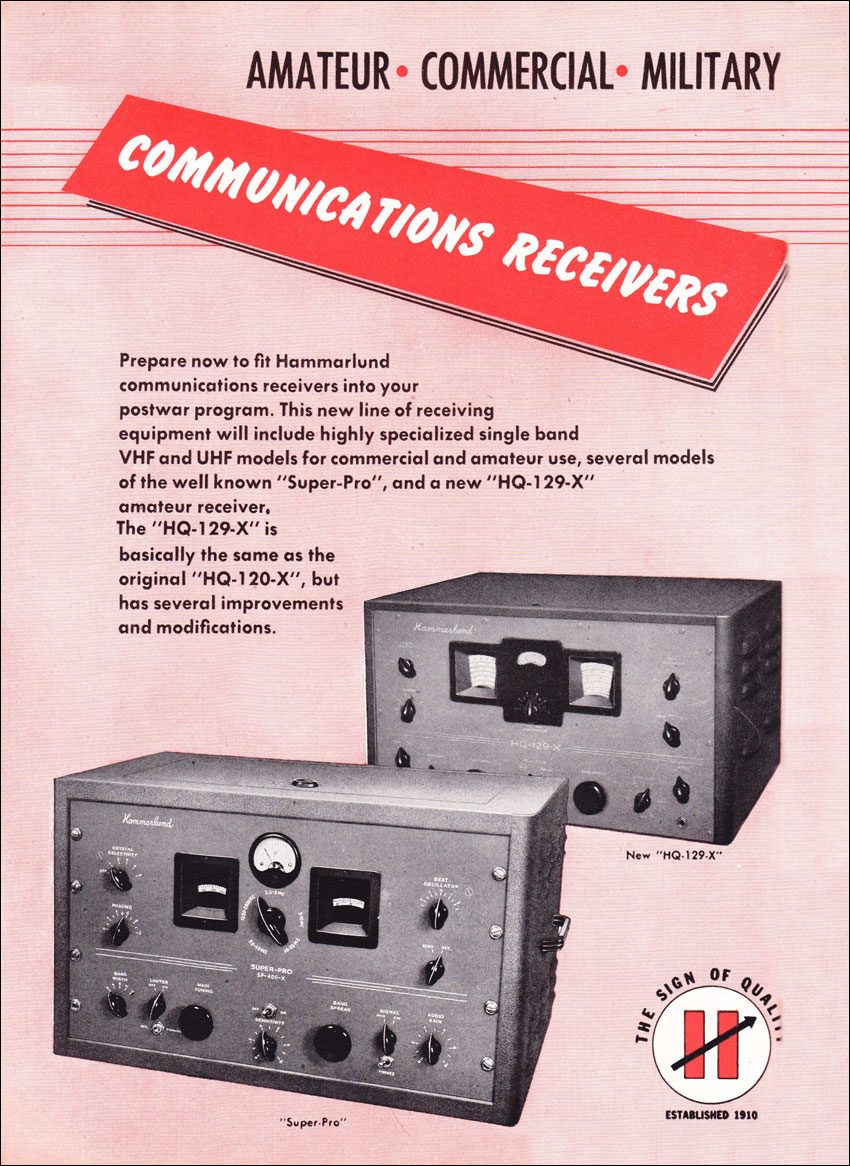
ARRL: The Radio Amateur’s Handbook, 1946
NZ Net tally board
Suggestions?
If you have suggestions on how to make the NZ Net better, or things you’d like to see covered in these newsletters, please contact ZL1NZ. Articles and photos will be gratefully received!
Thanks for reading, and I hope to hear you soon on the NZ Net!
—
Neil Sanderson ZL1NZ, Net Manager
New Zealand Net (NZ NET)

 Open the menu by clicking the “burger” icon at top right.
 Many menu items can be expanded to reveal subpages by clicking on the arrow. Click again to collapse the menu item.