
This is a free fortnightly newsletter about the New Zealand Net.
If you would like to be notified by email when a new edition is published, subscribe here.
Browse our Newsletter Archive and List of Net Tips.
Featured key

This is the Stampfl STM-12 Morse key, made by Heinz Stampfl HB9KOC of Switzerland.
Quick notes
 This concert promo flyer caught my eye during a recent trip to Whanganui. Don’t you think these would be great bands for the next NZART conference entertainment – based on their names, at least? 🙂
NZ Net shifts back to 3535 kHz for the winter, beginning Sunday 5 April, so now’s a good time to make sure your 80-metre aerial is in good order. This is also the day that New Zealand changes from Daylight Saving Time back to standard time. Although the net remains at 2100 hours NZT year-round, this is 0900 UTC during the southern winter.
The ZL sprint series starts 7 April at 0800 UTC (8pm NZST) and runs every Tuesday in that month. The event starts with 30 minutes of CW (followed by 30 minutes of SSB and then 30 minutes of FT4), all on 80 metres. The exchange for CW is always 599 (or 5NN) plus your outside temperature. The goal is to work as many stations as you can in any or all of the periods. Each mode is counted separately and you can work a station once per mode. Make sure you send your log in after each round. As an added bonus there will be a separate NZART branch competition. Simply include your branch number with your log and the scores from each branch will be added together. The soap box is just as important, with the best comments published with the results. See rules.
Photo flashback

Photo: K9TN
Tom K9TN describes the scene pictured above:
“Jock White ZL2GX visiting Ed W2PDB in the early 1960s. Jock was the first ham to get 300 countries confirmed! My dad was W2PDB, later W9BM, and I was WB2PGM, now K9TN. Yes, Jock came at 2:10 am!”
Maybe Jock was keen to check overnight propagation? Even so, he took care to wear a suit, just as all New Zealand amateurs do when operating their radio stations. 🙂
Ed’s very tidy station included a 75A-3 receiver and an HT-37 transmitter with the matching HA-1 keyer.
The key to letting go: a collector’s journey

By 2002, the cabinet held almost 200 keys, and there were another half dozen on David’s desk
By David ZL2WT
As the 20th Century drew to a close, I found myself auditing the unfinished business in my life thus far — the goals that had lingered, unfulfilled, on my bucket list. Some were adventurous, like learning to sail a yacht; others were tactile, like owning a radio room clock. But it was one goal that proved the most elusive: acquiring a Marconi Marine Morse key.
The search for the “Marconi 365” became an obsession. They surfaced occasionally on eBay, but I was perpetually outbid by deeper pockets. However, as I scoured classifieds, antique shops, and amateur radio rallies, word began to spread. I became “the man looking for keys.” For reasons I can no longer recall, I began purchasing virtually every key offered to me. At a steady acquisition rate of one per week, my collection swelled to over 250 pieces within five years. Among the hoard, I finally secured several coveted Marconis.
For the serious collector, the appeal lies in the provenance. We become detectives, researching the history of every key — where it was installed, the ships it sailed on, and the operators who used it to send traffic. It is a fascinating hobby that fostered friendships with fellow enthusiasts across the globe.
Eventually, however, I hit a wall.
The keys I found most significant were being “lost” in the clutter of the sheer volume I had amassed. I was reminded of a New Zealand museum curator who once wrote: “if you can walk past your collection and not give it a second glance, then it is time to find another interest.”
Fortunately, by then, Trade Me had arrived, and I found guidance in the words of Edmond de Goncourt (1822-96), who wrote:
“It is my wish, that my drawings, my prints, my curiosities, my books — in short, these works of art which have been the delight of my life – shall not be consigned to the cold tomb of a museum and subjected to the stupid glance of the careless passerby. Instead I require that they should be dispersed under the auctioneer’s hammer, so that the pleasure I have had in acquiring every one of them shall be given again, in every case, to some inheritor of my tastes.”
 Guided by this sentiment, I began the process of dispersing my collection. It has been a pleasure to see these items find new life.
Recently, I returned a key to its previous owner, who had spent 22 years regretting the day that he sold it to me. In another instance, I identified a key (pictured) as the personal key of the radio officer who was aboard TEV Wahine when it struck Barrett Reef in 1968; returning that piece of history to the officer’s family was a rare privilege.
I still hold onto a few select Marconi 365 keys — parting with those remains a bridge too far for now. But looking back, the true joy wasn’t just in the brass, bakelite and wood, but in the hunt, the history, and the eventual hand-off to the next generation of collectors.
Video: Bouncing along…
Steve ZL2KE found the following video online. It is described as training during World War 2 for radio operators who would serve in the German Panzer (tank) corps. Tanks aren’t noted for their smooth ride apparently.
Maybe we need something like this to prepare us for New Zealand’s earthquakes?
Net tip: QRM
We continue our look at Q signals with QRM.
This is one of those signals that most hams know, but it is rarely used to its full potential.
As a question, QRM? has two meanings:
- “Are you being interfered with?”
- “Am I being interfered with?”
Both meanings are quite useful, and the context should make it clear which one is meant.
As an answer, QRM has even more variations!
QRM by itself means either:
- “I am being interfered with.”
- “You are being interfered with.”
Plus, either of these answers can take a value of 1-5, with the following meanings:
- nil
- slightly
- moderately
- severely
- extremely
What a lot of information!
As an example, I might send the following:
UR QRM3 QRM?
meaning: “You are being interfered with moderately. Am I being interfered with?”
It would be great to hear more hams using QRM to its full extent!
The A-Z of Q Signals
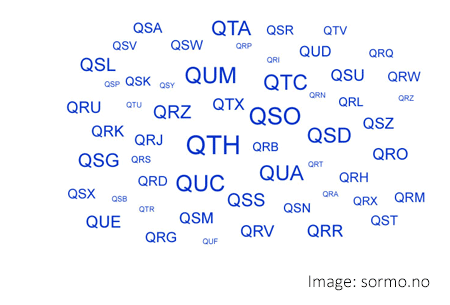
A well-run CW net is a lovely thing to experience. Communication between stations is quick and concise, and the net business is conducted with minimal time wasted.
As CW operators, we have many techniques to communicate quickly and efficiently. And if we know and use these techniques, we can often match or exceed the speed and accuracy of voice communication.
One of our most important tools is the set of Q Signals (or Q Codes), and in this series we look at the “essential” ones, in alphabetical order.
Advertising archive

Ham Radio magazine, Mar 1978
Suggestions?
If you have suggestions on how to make the NZ Net better, or things you’d like to see covered in these newsletters, please contact ZL1NZ. Articles and photos will be gratefully received!
Thanks for reading, and I hope to hear you soon on the NZ Net!
—
Neil Sanderson ZL1NZ, Net Manager
New Zealand Net (NZ NET)


 Open the menu by clicking the “burger” icon at top right.
 Many menu items can be expanded to reveal subpages by clicking on the arrow. Click again to collapse the menu item.