
This is a free fortnightly newsletter about the New Zealand Net.
If you would like to be notified by email when a new edition is published, subscribe here.
Browse our Newsletter Archive and List of Net Tips.
Featured key

SINUS key made for Radio Holland
By Herman VK2IXV
More on the SINUS company, which was in operation between 1920 and 1939. This a follow-up on the story of my SINUS key in NZ Net News 151.
I had contact with a Mr de Bruyn in Zeist, the Netherlands, who for 40 years has been collecting information about the company SINUS. Although not a Morse key collector, he is an expert in anything relating to SINUS products, namely broadcast receivers for the general public, plus transceivers and SINUS Morse keys built for the Dutch Armed Forces.
(On the older Morse keys the nameplate reads: Fa Ridderhof & van Dijk Zeist. (Fa is short for Firma = Company). Only after 1933 was the name SINUS used on the nameplates and engraved on other parts of the keys.

An early SINUS factory
The picture above shows an early SINUS factory. Apparently, the owners, Messrs Ridderhof and van Dijk, lived nearby.

SINUS Soundless key
Although he keeps trying, Mr de Bruyn has not been able to find any further information on Sinus Morse keys – not in Dutch museums, not from Radio-Holland, nor from former Sinus employees, Morse key collectors and radio enthusiasts.
Besides my SINUS key and the SINUS Soundless key (where the stationary contacts were replaced by springy leafs), SINUS made several other Morse keys.
Quick notes
 More noise. Martyn ZL3CK reports he now has QRN2 (see photo). Anyone got QRN3 yet? Send a photo. 🙂
Rydberg atoms detect radio signals. Rydberg-atom sensors can perform demodulation and down conversion automatically, says US researcher Christopher Holloway. “In principle, these Rydberg receivers could eliminate a lot of the front-end devices and electronics when compared to conventional receivers.” The atoms in the experimental detector are highly excited, and who can blame them? Read more.
Manic Mondays are a way to practise your CW at speeds of 30 wpm or more. Listen for VK3QB, VK3OU and VK3VB at 1100 UTC on or near 7028 kHz.
Wanted: I have people looking to buy dual-lever paddles (e.g. Bencher BY1) at a reasonable price. Also a couple of overseas people who would like to purchase the elusive KEA keyer. If you have either item for sale, please contact ZL1NZ.
Long Island CW Club has been named 2026 Club of the Year by Dayton Hamvention.
Our 7th anniversary! Wed 25 March will be the seventh anniversary of NZ Net. That’s a lot of netting!
The Commonwealth Contest is this weekend, from 1000Z Sat to 1000Z Sun. It’s a CW-only event. Get info.
Photo flashback

Paul Burke on 500kHz watch at Awarua Radio ZLB in the late 1970s
Net numbers
NR4 R ZL1NZ 43/40 AUCKLAND 0800Z 2MAR26
=
NZ NET
=
FEB QNI EA7ST 1 VE7WD 1 VK3DRQ 23 VK4PN 15
ZL1AJY 4 ZL1ANY 23 ZL1BDS 6 ZL1NZ 18 ZL1PX 21
ZL2GD 14 ZL2KE 17 ZL2LN 11 ZL2TE 14 ZL4GW 12
ZL4KX 15 ZL4LDY 3 ZL/W5ESE 1 TOTAL 199 QTC 32
=
ZL1NZ
Field Day fun
NZ Net News went behind the scenes as the ZL1XH team prepared for the annual Jock White Field Days two weeks ago. In the video below, Neil ZL1NZ can be seen tweaking the 80m logging hardware, which used a traditional GUI.*
* Graphite User Interface
In a bold departure from tradition, the 40m team at 1XH decided to try computer logging for the first time (see photo below with Paul ZL1AJY). The verdict: not as fast as pencil and paper, and vulnerable to typos, especially with a first-time user.
Which system will the team use next year? That’s being debated.

In other Field Day news:
- Greg ZL4GW reports an enjoyable time at ZL4AA where he operated mostly on 40m. Otago Branch 30 had four CW operators. Impressive.
- Graeme ZL1BDS was with Blenheim Branch 22 (ZL2KS) and says: “We were short of operators this year with essentially only two of us able to do CW. I rested during the voice periods and operated during the second half hour, mainly on 40m with a few stints on 80. I think there was more CW activity this year.”
- Two net members, Grant ZL2GD and Stephen ZL1ANY, provided much-appreciated contacts from their home stations. Grant really went the extra mile, having had surgery just two weeks before. “I can walk without the crutches now but not going too far at this stage,” he says. “During the JWFD, I managed to complete a half hour on the paddles with half an hour lying back down in bed…. it seemed to work OK. My XYL thought I was mad but I do enjoy a good contest.” Not only does Grant have a new hip, he also has a shiny new IC-7610. No wonder he couldn’t resist getting on the air.
W5ESE checks in
Scott ZL/W5ESE, who is in New Zealand to hike the Heaphy Track, has checked into the Net several times recently, so I asked him to tell us a bit about himself. He says:
I was licensed in the US in 1976. I participated in the Texas CW Net for many years and was familiar with ARRL radiogram format and CW net procedures. Your RSN signal reporting scheme is new to me, though. I’m familiar with QRK/QSA and RST.

Here is a picture of my home shack which you can see is quite modest. I use the Vibroplex Lightning Bug most of the time. My antenna is an inverted L. The radio is an old Ten Tec Argonaut 509. I dabble a little in some of the contests.
And here is my portable setup. Not a lot to see, I’m afraid.

I’ve enjoyed meeting some of the ZL CW community on the air. I may be QRV briefly from Nelson shortly before I leave NZ on 19 March. You have a great CW net here with efficient protocols.
Net tip: QRL
We continue our look at Q signals with QRL.
It means: “I am busy.”
As a question, QRL? means “Are you busy?”
A typical situation would be when you hear a station you want to contact, but you’re not sure if they are working someone else. A quick QRL? would be appropriate.
Many hams use QRL? to ask if a frequency is being used. The reply should be either “Yes” (or “QRL”) or silence. “No” is not a valid answer as none of us can say with certainty that a frequency is not in use.
Here are some operators who are definitely QRL:

The A-Z of Q Signals
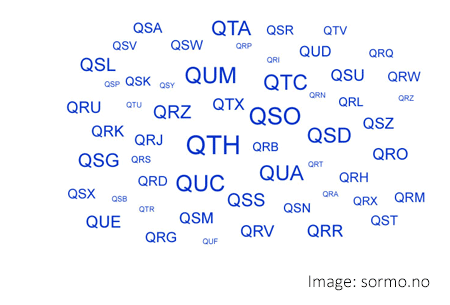
A well-run CW net is a lovely thing to experience. Communication between stations is quick and concise, and the net business is conducted with minimal time wasted.
As CW operators, we have many techniques to communicate quickly and efficiently. And if we know and use these techniques, we can often match or exceed the speed and accuracy of voice communication.
One of our most important tools is the set of Q Signals (or Q Codes), and in this series we look at the “essential” ones, in alphabetical order.
Access denied
 By Neil ZL1NZ
I did not check in to the net on Thursday 12 March, and the reason is kind of funny.
I went to the shack at about a minute before net time, put the key in the padlock on the door, turned the key but nothing happened. Tried the reserve key, poked and prodded the lock, but no luck.
Trying to remove it in the dark didn’t seem like a good idea, so no net for me.
The problem was solved the following morning with a little help from my angle grinder.
Advertising archive

The SX-28A was a post WW2 civilian version of the wartime SX-28
Suggestions?
If you have suggestions on how to make the NZ Net better, or things you’d like to see covered in these newsletters, please contact ZL1NZ. Articles and photos will be gratefully received!
Thanks for reading, and I hope to hear you soon on the NZ Net!
—
Neil Sanderson ZL1NZ, Net Manager
New Zealand Net (NZ NET)


 Open the menu by clicking the “burger” icon at top right.
 Many menu items can be expanded to reveal subpages by clicking on the arrow. Click again to collapse the menu item.