
This is a free fortnightly newsletter about the New Zealand Net.
If you would like to be notified by email when a new edition is published, subscribe here.
Browse our Newsletter Archive and List of Net Tips.
Featured key

The Hi-Mound MK-706 is a basic dual-lever paddle made in Japan. It has closely spaced paddles and adjustable bearing tension. The base is powdercoated steel. A plastic cover is included. Binding posts are on the rear of the key.
It’s available from Vibroplex or DX Engineering for US$139.95.
This key is available without the steel base as model MK-701 for US$79.95 from both the dealers mentioned above.
Quick notes
 Net manager Neil ZL1NZ (pictured on the left) visited Monday net controller Graeme ZL2TE and Ngaire ZL2UJT in New Plymouth a few days ago. Graeme and Ngaire are enjoying their new home in a retirement village, and putting out a very good signal on HF with their inverted L aerial.
Leadership change at NZART. Warren ZL2AJ is the new president of the NZ Association of Radio Transmitters, following the resignation of Daniel ZL2DRV.
The EU Bug Net is on the air each Thursday at 1830Z, so if you’re an early-riser in NZ perhaps you can work these folks when the greyline is favourable. Chris G5VZ reports that the net can be found on 3533 kHz during the northern winter, changing to 7031 kHz during the northern summer.
Grant ZL2GD suggests that anyone looking for a CW ragchew could try listening on 40m during the day for Ian ZL2AIM and friends who can often be found chatting.
Photo flashback

Paul Horowitz W1HFA, seen here with a Vibroplex bug, was licensed in 1950 at age 8. He is co-author of The Art of Electronics and is currently Emeritus Professor of Physics and of Electrical Engineering at Harvard University.
Net numbers

NR3 R ZL1NZ 39/36 AUCKLAND Ø8ØØZ 2FEB26
=
NZ NET
=
JAN QNI KA2BKG 1 VK3DRQ 3Ø VK4PN 13 ZL1AJY 9
ZL1ANY 31 ZL1BDS 27 ZL1NZ 27 ZL1PX 23 ZL2GD 14
ZL2KE 22 ZL2LN 13 ZL2TE 11 ZL4GW 27 ZL4KX 14
ZL4LDY 6 TOTAL 268 QTC 41
=
ZL1NZ
Looking for paddles
By Neil ZL1NZ
 In the past couple of weeks I have been contacted by two radio amateurs wanting to buy some basic dual-lever paddles so they can get into CW. What’s more interesting, is that both gentlemen told me they had been watching the Trade Me website for quite a while but hadn’t seen such keys offered for sale.
My impression is that they’re right. I have seen lots of old straight keys on TM, often with very high asking prices, but quality bugs and paddles seem scarce.
Is this because people are hoarding keys? In “the old days” a ham might have one or two keys. But now we see many CW ops with significant collections, occasionally hundreds of keys. And that’s despite the fact that we have dozens of people around the world producing keys, rather like the heyday of landline Morse a hundred years ago.
Getting back to the hams who are looking for paddles, my suggestions are:
- visit radio junk sales
- ask at your radio club if anyone has a key to sell
- place a “wanted” advert in Break-In, on ZL HamAds and in NZ Net News
I also recommend that newcomers start with a fairly inexpensive but well-made key, such as the Bencher BY-1 (pictured), or possibly the Hi-Mound shown at the top of this newsletter, although I have never used that model.
I urge them to avoid “copies” of the Bencher, some of which are really bad. Also, they should be aware that there is a Bencher ST-1 which looks very much like a BY-1 but it is a single-lever paddle. (I have both and still have to look carefully to tell them apart.)
Do you have a key to sell? Send me a message and I’ll put you in touch with possible buyers, or advertise it here in NZ Net News if you like.
Morse challenge
Here is a short excerpt from the EU Bug Net of 29 Jan 2026, in which the net control station is introducing himself.
Your challenge is to tell me the net controller’s name, location and type of bug they are using.
Send your answer to ZL1NZ via radiogram (or email if no RF connection available).
Recording courtesy DL5CL. Hear more.
Answer to previous Morse challenge: Tamatea. Correct answers were received from G5VZ, VK6RR, ZL1ANY and ZL2KE.
Video
Net tip: QRI
We continue our look at Q signals with QRI.
This is one you won’t hear often but it’s worth keeping mind, especially if you have adopted the RSN method of signal reporting, which does not include a tone report.
QRI means: “The tone of your transmission is: 1 (good) or 2 (variable) or 3 (bad).”
Conversely, QRI? means “How is the tone my of transmission?”
The A-Z of Q Signals
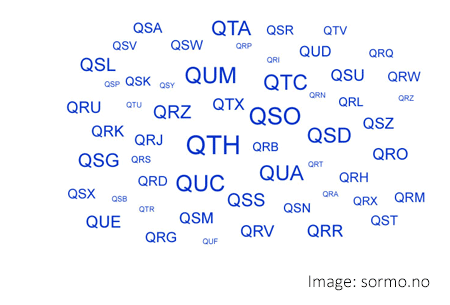
A well-run CW net is a lovely thing to experience. Communication between stations is quick and concise, and the net business is conducted with minimal time wasted.
As CW operators, we have many techniques to communicate quickly and efficiently. And if we know and use these techniques, we can often match or exceed the speed and accuracy of voice communication.
One of our most important tools is the set of Q Signals (or Q Codes), and in this series we look at the “essential” ones, in alphabetical order.
Advertising archive

Another version of the Delany Auto-Dot was our Featured Key in NZ Net News 176.
Suggestions?
If you have suggestions on how to make the NZ Net better, or things you’d like to see covered in these newsletters, please contact ZL1NZ. Articles and photos will be gratefully received!
Thanks for reading, and I hope to hear you soon on the NZ Net!
—
Neil Sanderson ZL1NZ, Net Manager
New Zealand Net (NZ NET)


 Open the menu by clicking the “burger” icon at top right.
 Many menu items can be expanded to reveal subpages by clicking on the arrow. Click again to collapse the menu item.