
This is a free fortnightly newsletter about the New Zealand Net.
If you would like to be notified by email when a new edition is published, please subscribe here.
Browse our Newsletter Archive and List of Net Tips.
Featured key

Photo: telegraphkeys.com
The Auto-Dot bug key was made by Delany Telegraphic Transmitter Company of New York City, c1907.
This one has a metal tag stating: “This machine is licensed but NOT guaranteed NOR manufactured by JE Albright, 253 Broadway, New York.”
Such tags were the result of patent enforcement in 1914-1915 by JE Albright, who were agents for Horace Martin’s Vibroplex bug. (Albright later bought out Horace Martin and formed the Vibroplex company.) Owners of “knock-off” semi-automatic keys had to buy the tag for US$2 or face legal action by Albright, which could also threaten the operator’s employer, e.g. the telegraph and railroad companies.
Partially visible beneath the tag on this key is a round red label, possibly indicating that they key had been purchased from WF McDonald & Company in Chicago.
And here’s a video of an Auto-Dot in use.
Quick notes

Re: car registration plates that look like Q Signals (NZ Net News 175), Martyn ZL3CK says: “My number plate is appropriate for reception at this QTH – it’s QRN.” 🙂
Digital Traffic Network introduction. Dave ZL4LDY participated a few days ago in a video presentation about the Digital Traffic Network in the USA, and wonders who else might be interested in getting something like it happening in New Zealand. Here’s a recording of the online presentation. If you’re interested, give Dave a shout.
“CW is a vanishing art,” says Ron VE3FN in his latest blog post. “Other than contest weekends and DXpeditions there is little to be found on the bands. When you do find stations to work, they are the same ones you worked yesterday.” Ron’s post is titled: Digital Modes Have Already Won. What are your thoughts?
Photo flashback

Radio room, passenger liner SS Rotterdam
Video: CW operation with the IC-7300, part 1
The IC-7300 is probably the most popular radio among NZ Net operators. Here are some tips on getting the most out of its CW capabilities.
In the next edition: Auto-Tune on the IC-7300.
Net tip: QRG
We continue our look at Q signals with QRG.
It means: “Your exact frequency (or that of …) is …”
As a question, QRG? means “What is my exact frequency (or that of …)?”
The A-Z of Q Signals
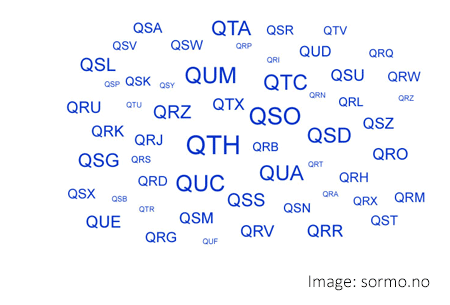
A well-run CW net is a lovely thing to experience. Communication between stations is quick and concise, and the net business is conducted with minimal time wasted.
As CW operators, we have many techniques to communicate quickly and efficiently. And if we know and use these techniques, we can often match or exceed the speed and accuracy of voice communication.
One of our most important tools is the set of Q Signals (or Q Codes), and in this series we look at the “essential” ones, in alphabetical order.
Advertising archive

1938
Suggestions?
If you have suggestions on how to make the NZ Net better, or things you’d like to see covered in these newsletters, please contact ZL1NZ. Articles and photos will be gratefully received!
Thanks for reading, and I hope to hear you soon on the NZ Net!
—
Neil Sanderson ZL1NZ, Net Manager
New Zealand Net (NZ NET)


 Open the menu by clicking the “burger” icon at top right.
 Many menu items can be expanded to reveal subpages by clicking on the arrow. Click again to collapse the menu item.