
This is a free fortnightly newsletter about the New Zealand Net.
If you would like to be notified by email when a new edition is published, subscribe here.
Browse our Newsletter Archive and List of Net Tips.
Featured key
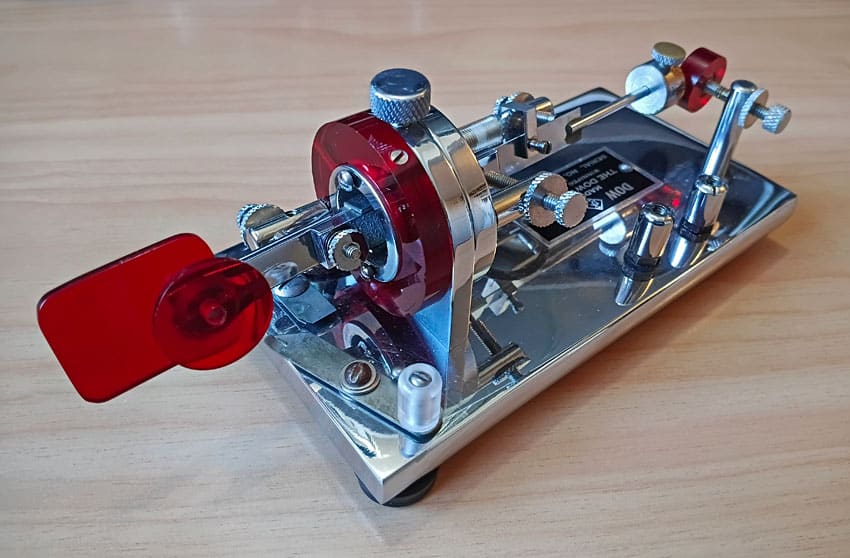
This Dow-Key Universal bug is the Deluxe (chrome base) version from the second design (damper attached to the base rather than to the rotatable frame). It is shown with a slight rotation to the left. Photo: ZL1NZ
By Herman VK2IXV
Paul Dow was born in Canada in 1885 and started making speed keys in 1942. He based his manufacturing decisions on his own experience as a practising telegrapher. His company, DOW-KEY, had an office in Winnipeg and another one in the USA.
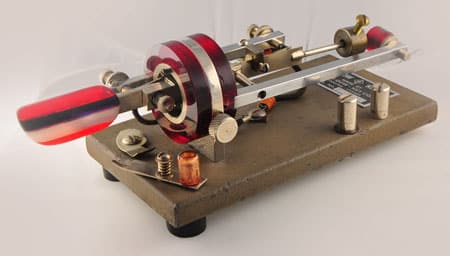
The first Dow-Key Universal bugs had the damper attached to the rotatable frame
The Dow Universal bug keys were only advertised between 1949 and 1951 and, according to reliable sources, no more than 2000 were produced. In 1952, when it became apparent that there was not enough money to be made in the Morse key business, the company started to concentrate on the development of their electro-mechanical coaxial relays and switches.
In 1956 Paul Dow retired and, a year later, aged 72, he became a Silent Key. The company ceased producing bugs, but Paul’s second son, Gordon Dow, took over the business. Over the years the Dow-Key Company has changed hands several times. It still exists and continues to be one of the leaders in the design and manufacture of electro-mechanical switches.
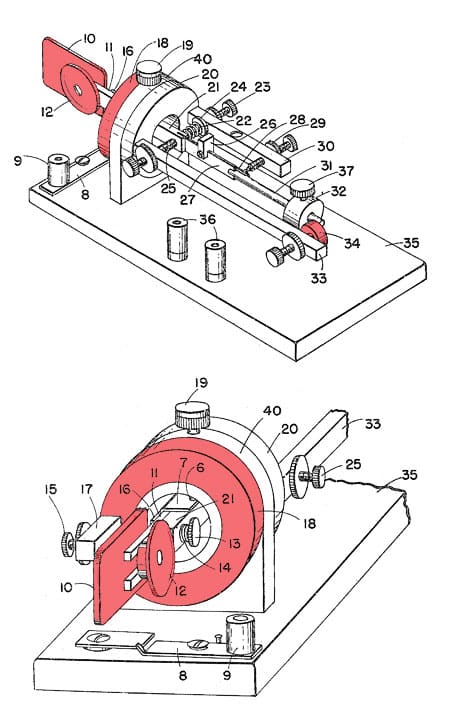
The first version of the Universal bug had the damper attached to the rotatable frame via a horizontal arm (33 in the diagrams). Image: Dow patent application
A journal bearing with a front flange (20) and a rear flange, slides over, and is supported by, a bridge bearing (40). The bridge does not move, as it is screwed onto the base of the key. A lock ring of red plastic (18) is secured with two screws to the outside of the rear flange of the journal bearing.
To enable rotation, the traditional vertical posts that hold a bug’s adjustable contact screws, bumper screws and tension spring, have been replaced by three horizontal arms. Two arms (30 and 33) are attached to the journal bearing’s front flange and another arm (17) is attached to the red plastic lock ring (18).
Inside, and attached to the journal bearing’s rear flange is the pivot-frame which acts as a support and hinge for the levers and the mainspring with pendulum.
The dash and dot contact adjustment screws on horizontal arms (17) and (30) are connected by cloth-covered copper wires to the base.
These wires have enough length and flexibility to allow the journal bearing, and thus the pivot frame, horizontal arms and attachments, to rotate unrestricted in a clockwise or anti-clockwise direction, maintaining at all times the dash and dot contact alignments.
The rotation can be locked or unlocked by a lock screw (19) on top of the bridge.
What are the advantages of this rotating bug?
According to the Dow-Key company, the Dow Universal bug:
(a) Permits using hand and forearm muscles in the manner in which they were intended to be used;
(b) By placing the vibrating arm in the extreme vertical position, the roll of sea-going craft and banking aircraft has negligible effect on vibrations; and
(c) Has a patented dot spring assembly capable of making upwards of 50 firm dots with one impulse.
My comments on the above points are:
(a) For relaxed, comfortable, controlled operations, the operator can not only slide the finger-pieces along the lever shaft, but also determine their best angle. Those factors make the Dow bug, in my view, even more anti-RSI than any other bug. By the way, my most comfortable position, being a left-handed sender on a right-handed bug, is to have the pivot frame turned approximately 10° to the right.
(b) A bit immaterial, since Morse code is no longer used on ships and aircraft, but I thought it would be interesting to find out how the Dow key performs on the sloping surface of a ship. I tested the Dow-Key bug and other inline bugs of the same vintage, at different angles. I noticed that when a ship rolls, bug keys still produce stable dots, if the angle of roll does not go beyond approximately 10 – 15° either side. When the tilt becomes larger than 20°, the pendulum weights start to make an impact on the pendulum swing and the dots deteriorate.
By rotating the Dow key’s pivot-frame in the opposite direction of the roll, the surface tilts become irrelevant and the dots remain perfect. However, on a rolling ship you would have to continuously readjust the rotation angle of the pivot-frame for left and right tilts, which does not seem very practical. I do recall that, when I was employed as a ship’s R/O, I stuck to my trusted hand-key on a badly rolling ship and only used a bug when seas were calm.
(c) With the dot contacts properly adjusted, I counted at least 20 perfect dots of equal length and space with one pendulum swing of the Dow bug, and about 10 perfect dots, followed by many half and even shorter dots per pendulum swing of several other bugs in my collection. The reason is that, compared to the usual elbowed dot spring, the Dow bug’s dot spring is straight, short and stiff, and is fastened to the mainspring rather than to the pendulum. This reduces damping and improves contact characteristics. Therefore, a thinner pendulum and a lighter pendulum weight are sufficient to produce a larger quantity of quality dots.
In summary, when compared to an ordinary bug, a Dow-Key Universal is gentler on your muscles, is less likely to make half or scratchy dots, and performs better on a tilted surface.
Quick notes
NZ Netters sprint to finish. April’s series of ZL Sprints proved very popular, with 17 stations in the CW section, including ZL2GD (winner), ZL2TE (3rd place) and ZL1BDS (4th place). In the CW QRP section, there were 8 stations, including ZL2LN who placed 2nd. Great efforts from all concerned. Full results.
Field Days winners. Congratulations to the top stations in this year’s Jock White Field Days.
Northern Region: ZL1XH Branch 77.
Central Region: ZL2AS Branch 13.
Midland Region: ZL3RR Branch 68.
Southern Region: ZL4AA Branch 30.
Full results will be in the next Break-In magazine.
Media coverage: Tauranga radio volunteers answer cyclone call
Sangster Shield coming soon. This annual low-Power CW contest takes place next Saturday 16 May (one day only) between 2000 and 2300 NZT on 80 metres. This is a change from previous years, when the Sangster Shield ran over two days: Saturday and Sunday. Another change this year is that participants do not have to be NZART members. Maximum output power is 5 watts. Get details.
Free digital book: Amateur Radio Antenna Systems
Visiting Auckland? NZART conference is only a few weeks away. If you’re planning to be in Auckland, I hope you’ll get in touch so we can try to meet up. I will also be at Musick Point to show visitors around this historic radio station. (ZL1NZ)
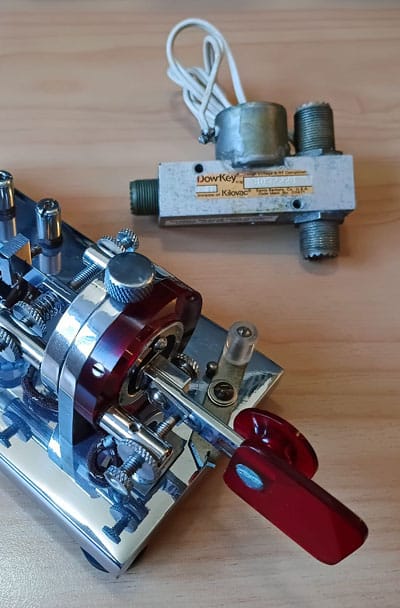
Photo: Two Dow-Keys 🙂
Photo flashback

Technicians Ray Allsop (sitting) and Rex Beechy at Wellington Radio ZLW in the 1950s. Courtesy Chris Underwood.
See more at maritimeradio.org
Net numbers
NR15 R ZL1NZ 37/34 AUCKLAND 0900Z 1MAY26
=
NZ NET
=
APR QNI VK3DRQ 27 VK4PN 14 ZL1AJY 5 ZL1ANY 28
ZL1BDS 27 ZL1NZ 29 ZL1PX 26 ZL2GD 19 ZL2KE 8
ZL2LN 14 ZL2TE 16 ZL4GW 19 ZL4KX 5 ZL4LDY 1
TOTAL 238 QTC 63
=
ZL1NZ
Video: Keying with a twist
When Herman VK2IXV offered me a chance to get this Dow-Key Universal bug a few months ago, I could not resist. Having lived in Winnipeg, I knew a bit about Paul Dow, a gifted inventor as well as an accomplished telegraphist. Winnipeg was a major transport hub, particularly for the shipping of grain by rail. The Winnipeg Grain Exchange and the railroads would have needed lots of professional Morse operators, so it’s no surprise that the Dow-Key was born there. This key would be from around 1951 and it’s in lovely condition.
-ZL1NZ
Net tip: QRQ, QRS
We continue our look at Q signals with QRQ and QRS, two signals with opposite meanings.
As a question, QRQ? means: “Shall I send faster?” while QRS? means “Shall I send slower?”
As a reply, or a direction, QRQ means: “Send faster” while QRS means “Send slower.”
It is best to add a number to each of these signals to increase their usefulness. For example:
QRS15 means “Send at 15 words per minute.”
QRS is sometimes useful when handling traffic in poor conditions.
The A-Z of Q Signals

A well-run CW net is a lovely thing to experience. Communication between stations is quick and concise, and the net business is conducted with minimal time wasted.
As CW operators, we have many techniques to communicate quickly and efficiently. And if we know and use these techniques, we can often match or exceed the speed and accuracy of voice communication.
One of our most important tools is the set of Q Signals (or Q Codes), and in this series we look at the “essential” ones, in alphabetical order.
Morse challenge
Send your answer by radiogram (or email if no propagation) to ZL1NZ.
The answer to the previous edition’s Morse Challenge was “three”. There were three HRO receivers visible in the photo of Nobby Clark at Auckland Radio ZLD. The correct answer was received from ZL1ANY, ZL1AYN and VK3DRQ.
Advertising archive
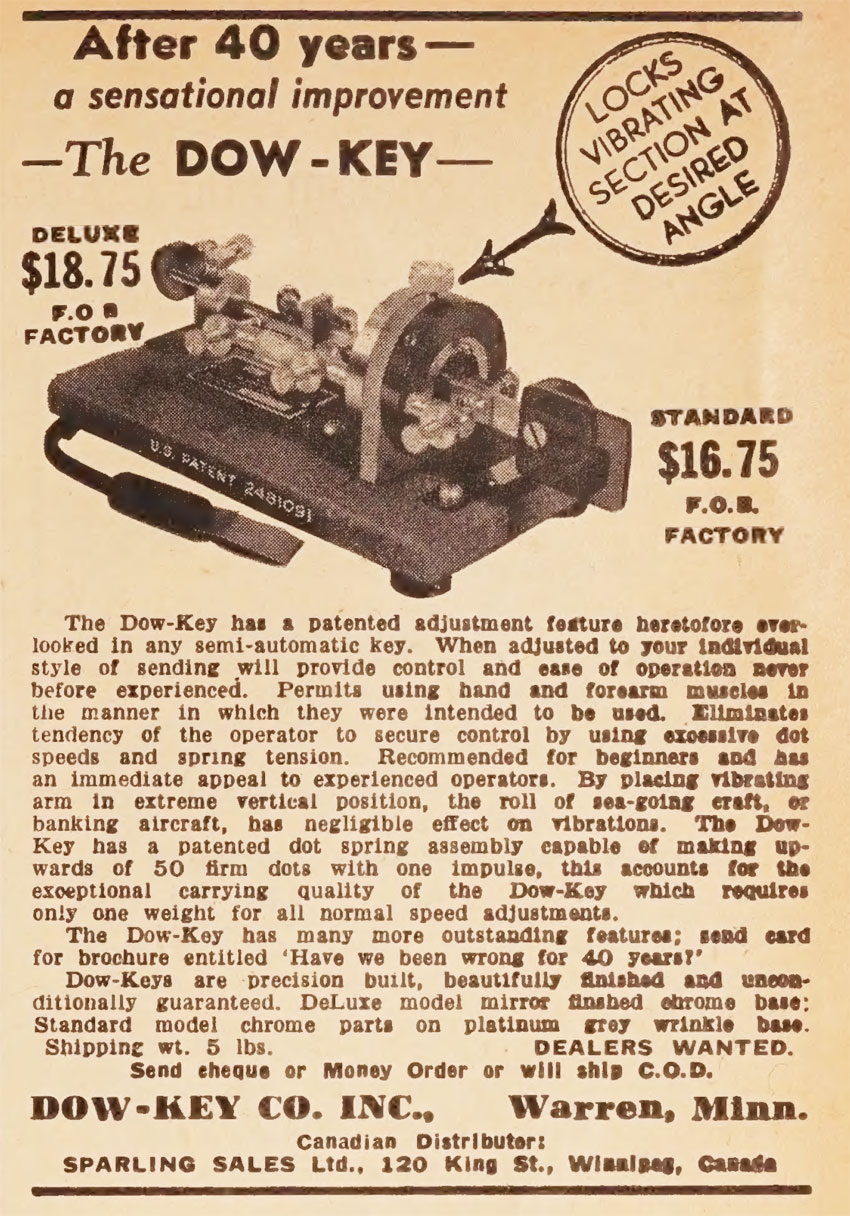
CQ magazine, April 1951
Suggestions?
If you have suggestions on how to make the NZ Net better, or things you’d like to see covered in these newsletters, please contact ZL1NZ. Articles and photos will be gratefully received!
Thanks for reading, and I hope to hear you soon on the NZ Net!
—
Neil Sanderson ZL1NZ, Net Manager
New Zealand Net (NZ NET)


 Open the menu by clicking the “burger” icon at top right.
 Many menu items can be expanded to reveal subpages by clicking on the arrow. Click again to collapse the menu item.