
This is a free fortnightly newsletter about the New Zealand Net.
If you would like to be notified by email when a new edition is published, subscribe here.
Browse our Newsletter Archive and List of Net Tips.
Featured key
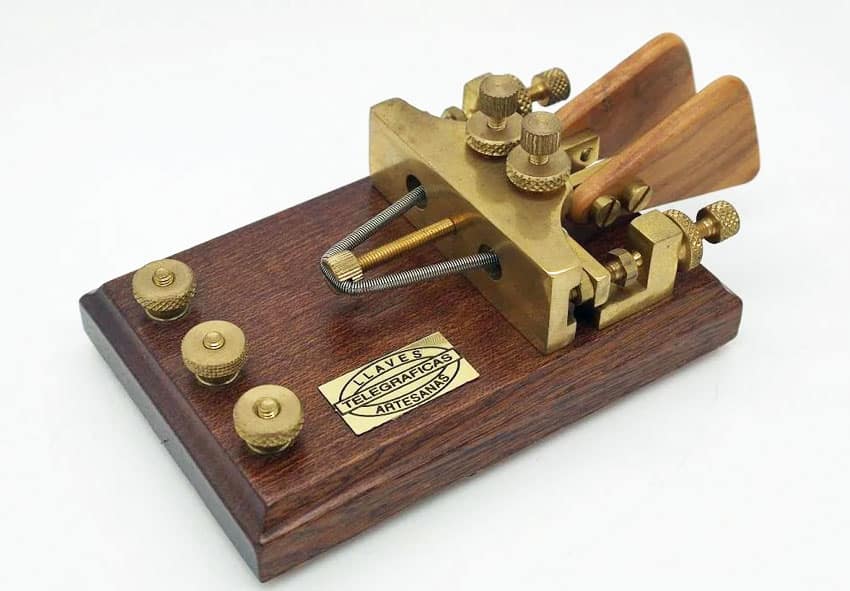
 Llaves Telegráficas Artesanas was a Spanish manufacturer of a wide variety of beautiful Morse keys.
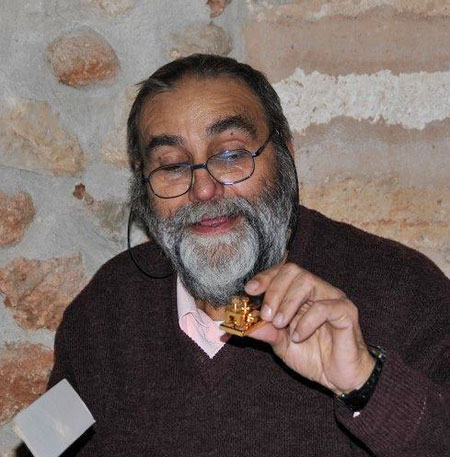
Based in the Balearic Islands, the company was founded by the late Guillermo Mestre Janer EA6YG (pictured).
In the top photo are the CRI dual-lever paddles, introduced in the late 1990s.
Tom Perera W1TP has posted lots of photos of Guillermo’s keys and factory.
Quick notes
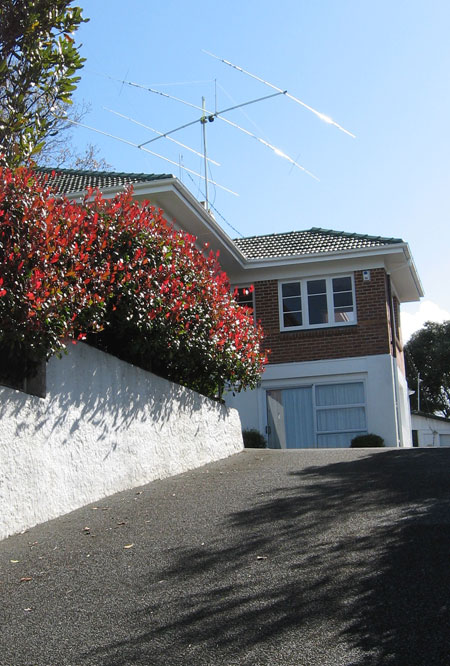 Saturday 25 April is ANZAC Day (see article below) and also Marconi Day (the 152 birthday of Guglielmo Marconi).
Sunday 26 April is the 103rd anniversary of the first trans-Tasman radio contact, between Frank Bell (callsign “BELL” at Shag Valley, Otago) and Charles Maclurcan (callsign 2CM) in Sydney.
Monday 27 April is Morse Code Day, the 235th birthday of Samuel Morse.
Cat Pix on the Air (CPOTA) is a new event which coincides with the annual International Cat Day on 8 August. It uses SSTV of course. Get details.
Kent Keys update: A US ham has posted a photo online of his new Kent straight key with the comment: “Here’s proof that Kent still exists. Took about 6 weeks to get it.” Over recent years, there has been doubt whether the German key maker was still operating. Many potential customers reported that their enquiries were not answered. And the company’s website looks very neglected.
Hy-Gain and Cushcraft revived. Martin F Jue, who closed his MFJ Enterprises manufacturing operation in 2024 after failing to find a buyer for the company, has sold two antenna brands to ITU Corporation in Indiana, which has bought a large building where it will make antennas.
Pictured: Cushcraft A4S yagi
3 days of radio events this weekend

Events on Anzac Day (Saturday 25 April)
 Mike VK4MIK is asking radio amateurs to operate with the two modes that were used during the world wars: CW and AM.
This is the 17th year for AM and CW on ANZAC Day, which is not a contest, but simply an opportunity to use traditional radio modes while honouring the Anzacs.
CW
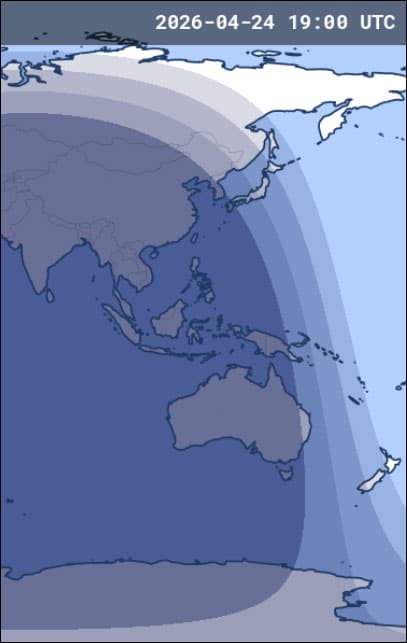
Rob VK4ARQ in Mount Fox, Queensland will run a CW net on 3599 kHz, from 1900 UTC (0700 NZT, 25 Apr) to 2030 UTC (0830 NZT) on Anzac Day. The start time will be a few minutes after sunrise in the North Island (see map). If any of our readers succeed in checking in, please let me know.
AM
At 2030 UTC (0830 NZT, 25 Apr) Australia’s Gnarly Net will begin on 3600 kHz AM, continuing until about 2130 UTC (0930 NZT).
From around 2300 UTC (1100 NZT, 25 Apr), operations will be on 7125 kHz AM from various locations, including:
- Townsville Amateur Radio Club AX4ATV will operate from a WW2 RAAF Command Bunker, and will be net control for stations covering most of Queensland.
- Ray AX4OIL will be operating from the WW2 Japanese Bomb Crater at Oonoonba, Townsville.
- ZL1ZLD at Musick Point in Auckland will be on the air from approximately 2200 UTC (1000 NZT, 25 Apr), using vintage gear.
Australian Military Radio Operators (AMRO) weekend, Sun 26 Apr & Mon 27 Apr
This event encourages CW and AM operation using vintage gear for casual contacts. Suggested frequencies are:
1818 kHz CW
3530 kHz CW
3686 kHz AM
3696 kHz LSB
7006 kHz CW
7028-7030 kHz CW
7060 kHz AM
7085 kHz LSB
7125 kHz AM [NET – PRIMARY LIASON FREQUENCY and may be busy]
7135 kHz LSB
10102 kHz CW
10125 kHz AM
14030 kHz CW
14125 kHz AM
14145 kHz USB
21030 kHz CW
21125 kHz AM
21135 kHz USB
and possibly some operation on 28 MHz
More information is available on the AMRO website.
Photo flashback
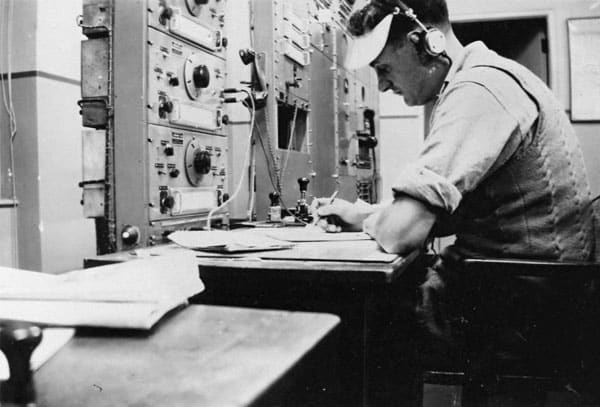
Nobby Clark at Auckland Radio ZLD in 1946
Compact keyer with tiny price
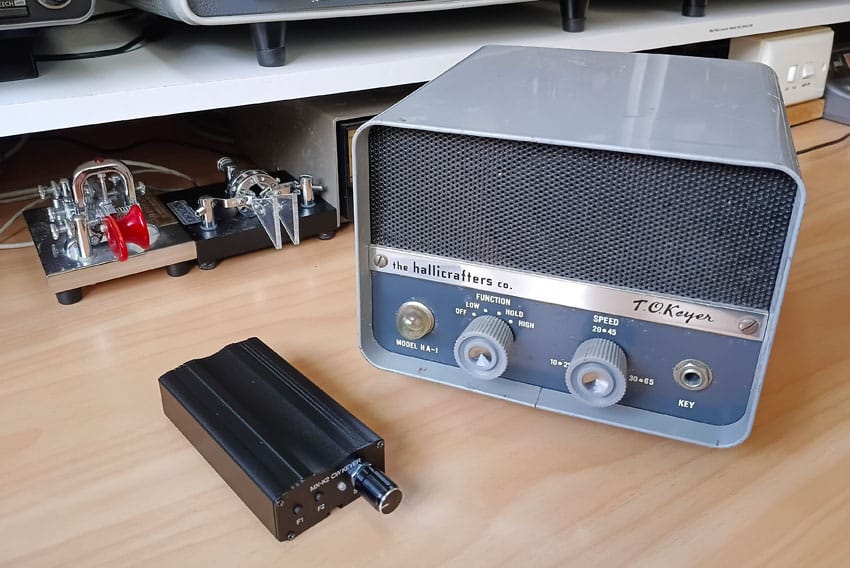
Photo: ZL1NZ
By Neil ZL1NZ
I’ve always been curious about the little MX-K2 keyers, so when I saw them on Ali-Express for NZ$15 including shipping I decided it would be a very low-risk purchase. Service was great, with the keyer arriving from China in less than two weeks.
First reaction: it sure is small! It measures 53mm wide, 25mm tall and 123mm deep (including the speed control knob). The weight is just 128g including 2 AAA batteries. In the photo above, it’s sitting beside the considerably larger Hallicrafters HA-1 keyer, which was manufactured around 1960.
Some people have reported quality-control issues with the MX-K2, but mine works fine. If you need a keyer for portable use, this could be a good choice.
And it’s a bargain. The Hallicrafters keyer shown above sold for US$80 in 1960. Adjusting for inflation, and the current exchange rate, that’s equivalent to NZ$1510 today – more than 100 times what the MX-K2 cost!
Having said that, my Hallicrafters keyer still works – at around 65 years old. I wonder if the MX-K2 will be working for a future ham in 2091.
Morse challenge
Send your answer by radiogram to ZL1NZ (or by email if you have no propagation).
Net tip: QRO and QRP
We continue our look at Q signals with QRO and QRP, a pair of signals with similar functionality.
As questions, QRO? means: “Shall I INCREASE power?” and QRP? means “Shall I DECREASE power?”
QRO is a direction to another station, meaning “Increase power” while QRP means “Decrease power.”
In amateur radio, such messages are pretty rare – but wouldn’t it be nice if we could send QRO to a station that’s hard to copy? 🙂
Did you know that in the very old days, it was a requirement for ships to send a warning before changing to high power? It gave everyone else a chance to protect their ears!
All stations are bound to exchange messages with the minimum power required for obtaining effective communication. If a station desires to make use of high power for special purposes, it must send the signal ––..–– repeated three times on its normal wave length as a warning. The high power transmission shall not commence until 30 seconds after this warning has been sent.
– Wireless Telegraphy Course for the Postmaster General’s Certificate, Gilby’s College, Christchurch NZ
There’s a good reason for using the signal dah-dah-di-di-dah-dah – it was the exclamation point in International Morse until 1939 when it was redefined as the comma, leaving us without an official exclamation point. (Read more in NZ Net News 38)
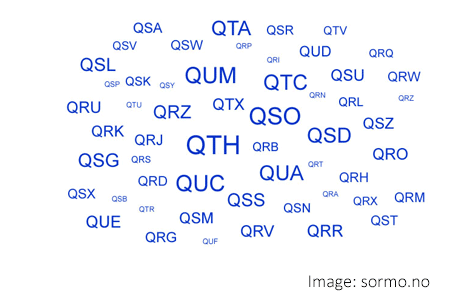
The A-Z of Q Signals
A well-run CW net is a lovely thing to experience. Communication between stations is quick and concise, and the net business is conducted with minimal time wasted.
As CW operators, we have many techniques to communicate quickly and efficiently. And if we know and use these techniques, we can often match or exceed the speed and accuracy of voice communication.
One of our most important tools is the set of Q Signals (or Q Codes), and in this series we look at the “essential” ones, in alphabetical order.
Advertising archive
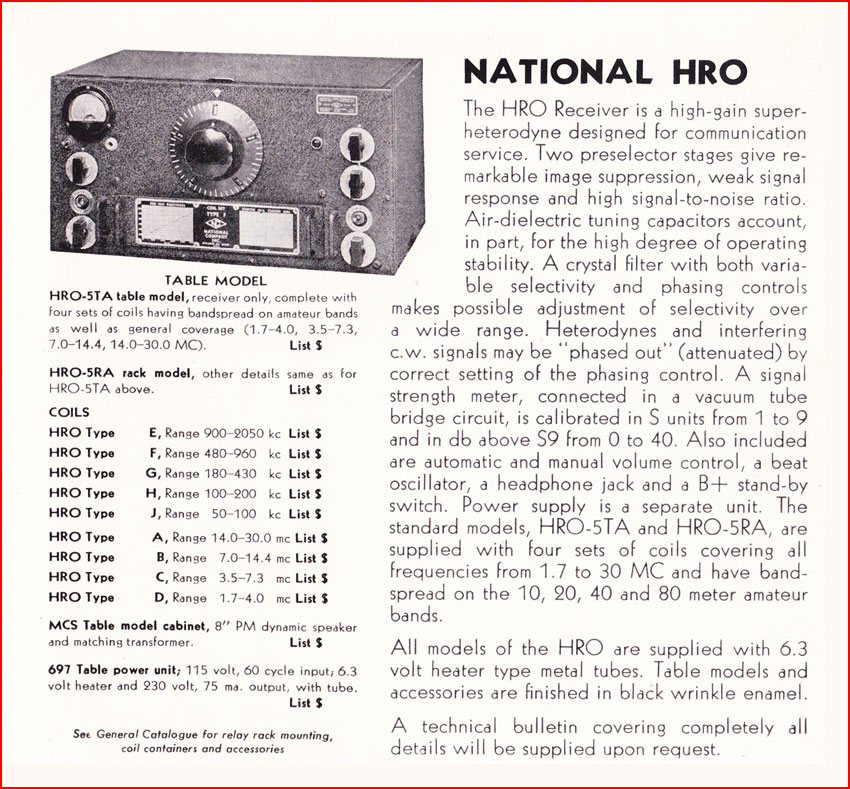
ARRL: Radio Amateurs Handbook, 1946
I don’t know the reason, but National’s advertising in the 1946 and 1947 ARRL handbooks had blank spaces for the prices.
HRO receivers came in many versions over the years, including the New Zealand-made Collier & Beale 941-SWB which was used in NZ Post Office radio stations and which is still in service at ZL1ZLD 85 years after these receivers were built.
Suggestions?
If you have suggestions on how to make the NZ Net better, or things you’d like to see covered in these newsletters, please contact ZL1NZ. Articles and photos will be gratefully received!
Thanks for reading, and I hope to hear you soon on the NZ Net!
—
Neil Sanderson ZL1NZ, Net Manager
New Zealand Net (NZ NET)


 Open the menu by clicking the “burger” icon at top right.
 Many menu items can be expanded to reveal subpages by clicking on the arrow. Click again to collapse the menu item.