
This is a free fortnightly newsletter about the New Zealand Net.
If you would like to be notified by email when a new edition is published, subscribe here.
Browse our Newsletter Archive and List of Net Tips.
Featured key
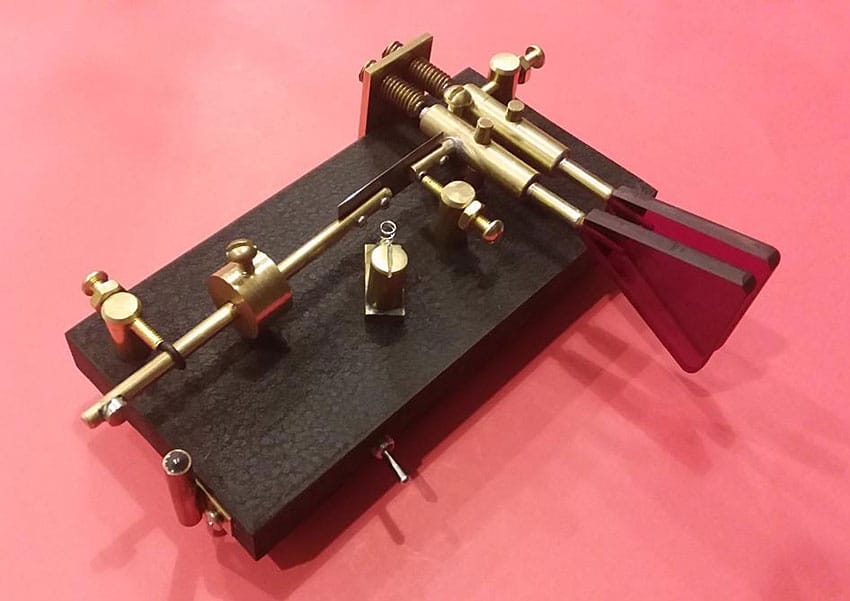
 Buck AA4SN, who lives in New Bern, North Carolina, loves to make bug keys.
Inline bugs, right-angle bugs or vertical bugs.
Spring returns or magnetic returns.
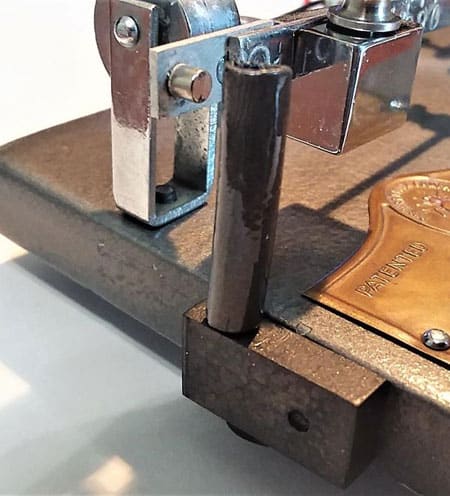
Traditional mechanical dit contacts or reed switches. Or both, easily selectable, as shown on the model pictured above.
Buck also makes a little kit for adding reed switching to your existing bug (see small photo). It attaches magnetically to the bug’s base. I would love to try one of those – it sounds like a cure for scratchy dits, which are a problem with so many bugs.
Thanks to Grant ZL2GD who spotted Buck’s keys after having a chat with him on 40 metre CW.
Quick notes
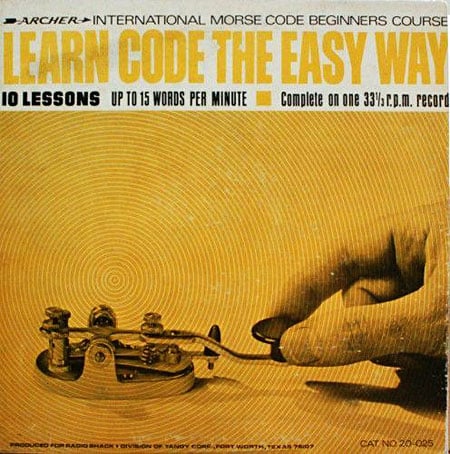 Did you use LP Records to learn Morse Code? The record shown here was sold by Radio Shack stores in the 1970s, and the same recording was available on cassette tape. There were other Morse training LPs on the market, including the so-called Rhythm Method produced by an English radio amateur (see the article later in this newsletter).
CW on 6. This weekend is the NZART VHF Low-Bands Contest on 6m, 2m and 70cm. A handful of Auckland amateurs are hoping to participate on CW, particularly on 6m since many modern HF transceivers include that band. Contact ZL1PSH for more info.
Cyclone Vaianu approaches. New Zealand is bracing for bad weather this weekend. Please make sure you have your emergency supplies and things are as secure as possible around your property.
Maritime Radio Day takes place from 1200 UTC on 14 April to 2200 UTC on 15 April 2200, which is the 114th anniversary of the Titanic disaster. Listen for activity, including QTCs on all HF bands, including WARC bands. CW only.
The CQMM DX Contest is an annual CW-only event, taking place on the third weekend of April. This year’s contest begins at 0900 UTC Saturday 18 April and ends at 2359 UTC Sunday. See rules.
World Amateur Radio Day is 18 April.
Photo flashback
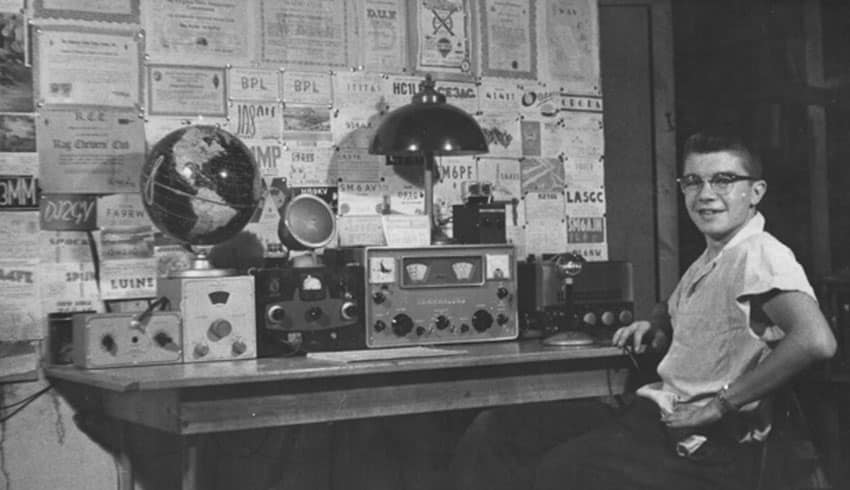
During our net session on the last day of March, Peter W1UU checked in from Falmouth, Massachusetts.
Peter’s been licensed since age 13 in 1954. The photo above shows him as a newly qualified General class licensee with callsign W1BPW in late 1955. As a General, he was allowed to put away the Morse key and operate ‘fone’. Fortunately, Peter returned to CW, where he is quite active, and we were glad to copy his fist during the NZ Net.
Net numbers
NR9 R ZL1NZ 43/4Ø AUCKLAND Ø8ØØZ 1APR26
=
NZ NET
=
MAR QNI VK3DRQ 31 VK4OP 1 VK4PN 9 W1UU 1
ZL1AJY 6 ZL1ANY 3Ø ZL1BDS 24 ZL1NZ 28 ZL1PX 22
ZL2GD 14 ZL2KE 12 ZL2LN 11 ZL2TE 15 ZL4GW 2Ø
ZL4KX 15 ZL4LDY 4 ZL/W5ESE 2 TOTAL 245 QTC 45
=
ZL1NZ
Tony Smith G4FAI
By Herman VK2IXV
I am adding a bit to the story about Tony Smith G4FAI (1933-2023) which appeared in NZ Net News 121.
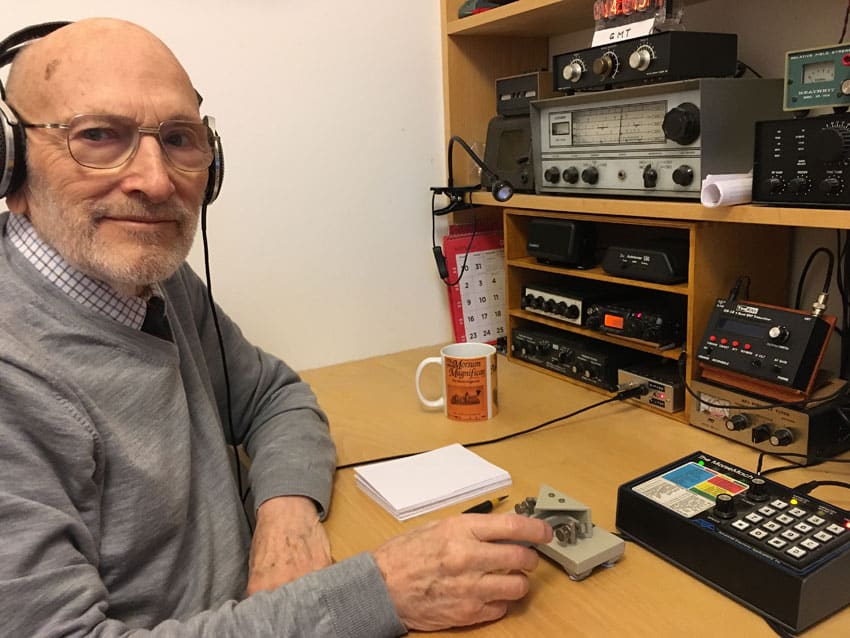
One of my Australian-made Simplex Auto jiggers (no. 5786) belonged to Tony, and I recently obtained it through his son Paul G8IAR.
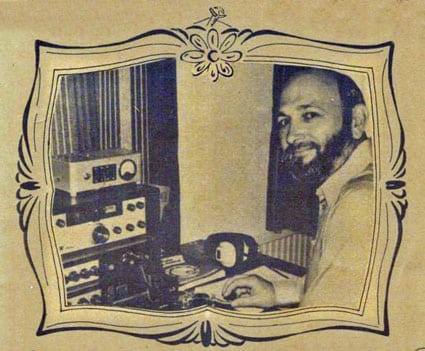 Tony was co-founder of the English edition of Morsum Magnificat (MM) and, together with Geoff Arnold G3GSR, was editor and publisher of MM between 1983 and 2000.
He wrote many informative articles about receivers, transmitters and Morse keys. An example is the worldwide survey of the famous pre-war, wartime and post-war military Morse key WT 8 Amp in MM28.
The small photo is of Tony Smith, with a Hi-Mound KH-708 Morse key, as published on the cover of MM1. The large colour photo, supplied by his son Paul, shows Tony at age 87 in 2020. The key on the desk is a 1988 Samson ETM-SQ, made by Hermann Samson DJ2BW. Please also note the Morsum Magnificat coffee cup. 🙂
Rhythm Method – Morse lessons on LP
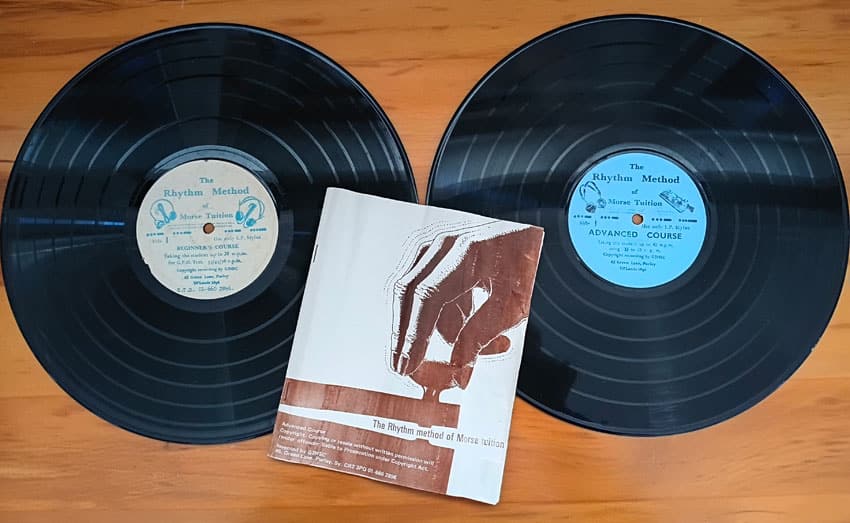
Photo: ZL1NZ
 By Neil ZL1NZ
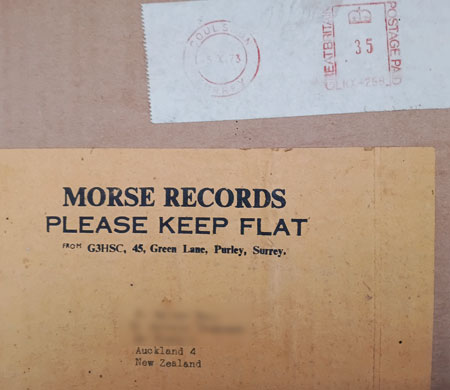
The Rhythm Method Morse training records were produced and sold in the 1960s by Stan Bennett G3HSC. I have a set, which was ordered in 1973 by an aspiring radio amateur in Auckland.
For a while, I’ve been planning to write something for the newsletter about these records. Then, a few days ago, I discovered that Ian EI3LH had already written a very entertaining item on the subject, so please have a look at Ian’s article.
Although a cassette tape would have been cheaper and easier to produce, vinyl records allowed the user to easily change the playback speed, e.g. playing the 33 1/3 rpm recording at 45 or even 78 rpm to practise copying at higher speeds. On the other hand, the student may have already memorised the text.
Here’s a funny bit. On the back of the user’s manual (seen in the top photo) G3HSC wrote: “TO ALL MOTORISTS: Why not send for details of our latest Police Radar Trap Spotter or “Speedset” audible speed warning device?”
Quite the entrepreneur. 🙂
Net tip: QRN
We continue our look at Q signals with QRN.
Like QRM, which we covered in NZ Net News 181, QRN has features that are untapped by most radio amateurs.
As a question, QRN? means “Are you troubled by static?”
As a reply, or as an unsolicited comment, QRN means “I am troubled by static.”
Plus, it has the same five variations as the QRM signal, namely:
- nil
- slightly
- moderately
- severely
- extremely
So, QRN1 means, in effect, “I am not troubled by static.”
Note that QRN refers to static, not human-generated noise.
Also, we don’t generally need QRN on NZ Net, because our RSN signal reports already include a noise value (on a scale of 1-9, rather than the 1-5 scale used by QRN).
The A-Z of Q Signals

A well-run CW net is a lovely thing to experience. Communication between stations is quick and concise, and the net business is conducted with minimal time wasted.
As CW operators, we have many techniques to communicate quickly and efficiently. And if we know and use these techniques, we can often match or exceed the speed and accuracy of voice communication.
One of our most important tools is the set of Q Signals (or Q Codes), and in this series we look at the “essential” ones, in alphabetical order.
Video: Bike bell beats noise-cancelling headphones
Advertising archive
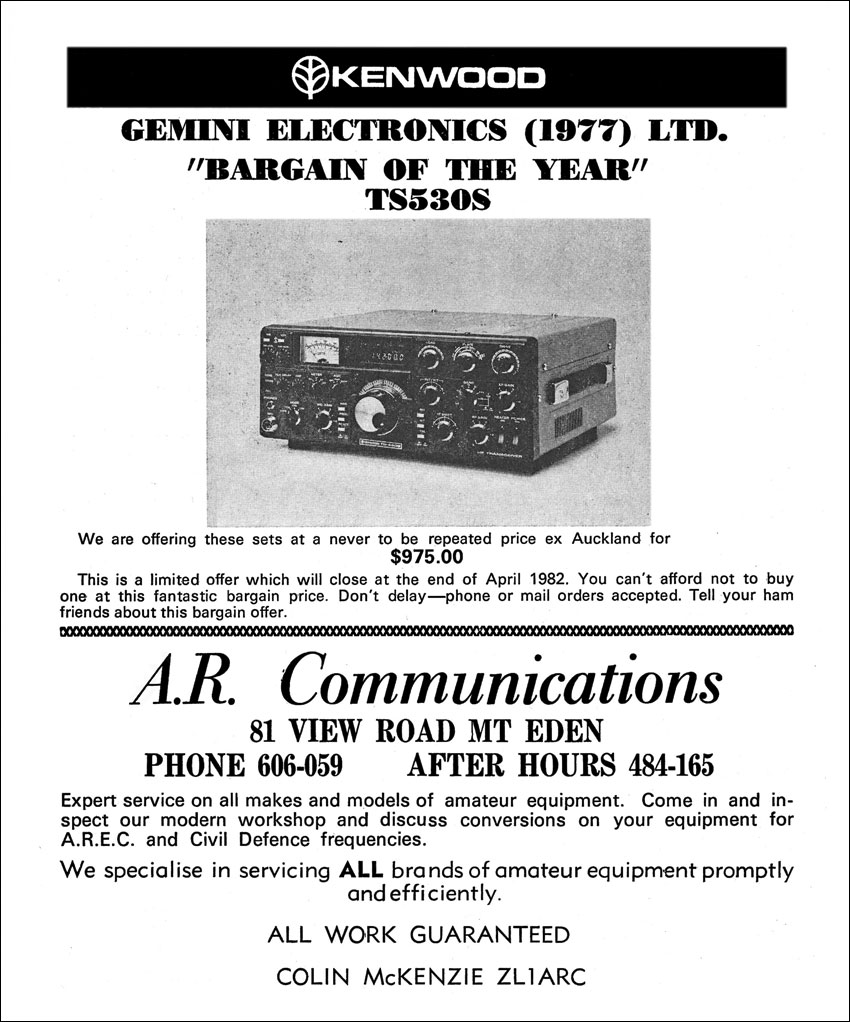
Break-In magazine, Mar 1982
Suggestions?
If you have suggestions on how to make the NZ Net better, or things you’d like to see covered in these newsletters, please contact ZL1NZ. Articles and photos will be gratefully received!
Thanks for reading, and I hope to hear you soon on the NZ Net!
—
Neil Sanderson ZL1NZ, Net Manager
New Zealand Net (NZ NET)


 Open the menu by clicking the “burger” icon at top right.
 Many menu items can be expanded to reveal subpages by clicking on the arrow. Click again to collapse the menu item.