
This is a free fortnightly newsletter about the New Zealand Net.
If you would like to be notified by email when a new edition is published, subscribe here.
Browse our Newsletter Archive and List of Net Tips.
Featured key
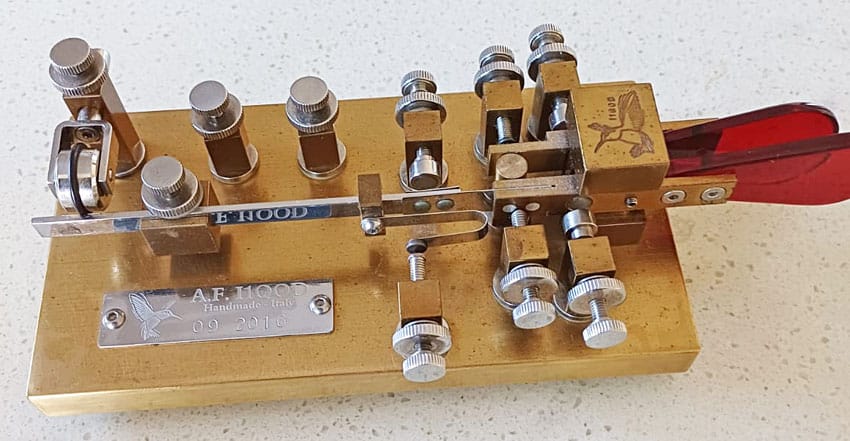
Photo: VK2IXV
By Herman VK2IXV
Expertly handmade by Alberto Frattini I1QOD (Italy) in 2016, this is a double lever magnetic bug. It is designed to send Morse code with a speed range of 15-40 wpm.
The difference between this Frattini magnetic semi-automatic and a conventional bug is that the dash Lever is separate from the dot lever. Compared to a conventional single lever bug, a dual lever bug, when used with good rhythm, shortens the time required to start the dash element and therefore prevents the problem of split dots, also known as half dots or scratchy dots.
Frattini’s bug uses magnets instead of springs, which can be adjusted more precisely and hold the settings better than springs. It uses repulsive magnets to control the tension for each side. It also has an additional “attractive” magnet mounted close to the vibrator, on the other side of the dot contact. This activates the vibrator with a minimal displacement and also improves the damping action, which is almost silent due to a damper wheel with an additional rubber ring.
The bug is built from highly polished brass, which is coated with a clear varnish for corrosion protection. Weighing 2.3 kg, it won’t move on the desk even if you are a bit heavy-handed.
This bug is slightly different from the more recently made Frattini bug described in NZ Net News 156. Other double lever bugs were made by Vibroplex, its second model (available 1911-1926), the GHD bug by Toshihiko Ujiie JA7GHD and Richard Meiss WB9LPU.
Quick notes
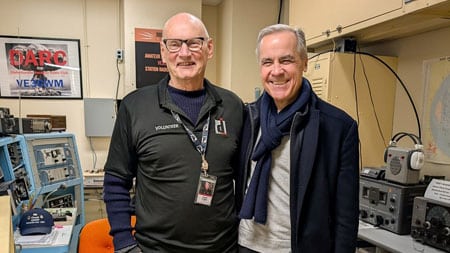
Canadian Prime Minister Mark Carney is being lauded for his recent speech at the World Economic Forum in Davos, Switzerland. But a week earlier he was seen posing with some classic amateur radio gear. The photo was taken underground in the Diefenbunker, near Ottawa, and the chap on the left is Diefenbunker volunteer Chuck VE3PFF.
Amateur radio was featured in a radio series called Jesse goes clubbing, broadcast Monday 26 January on RNZ National. Host Jesse Mulligan interviewed Warren Harris ZL2AJ.
Net responds to mysterious distress call
On Sunday 18 January, one minute before the start of NZ Net at 0800 UTC on 7030 kHz, a weak but audible SOS was heard.
The distress signal was sent several times, a few seconds apart, but with no callsign or other information. Although it wasn’t strong, the SOS was copied clearly by ZL1NZ, ZL1ANY and VK3DRQ.
Neil ZL1NZ responded to the call several times during the following minutes, but nothing further was heard from the station “in distress.” Neil then asked net controller Graeme ZL1BDS to go ahead with the net, reasoning that it was best to keep our group of CW ops on frequency, providing opportunities for the SOS station to get our attention again.
Nothing more was heard, but after the net Neil rang Taupo Maritime Radio ZLM and gave them the information for their log.
Manny VK3DRQ commented: “This was the second time for me to hear an SOS. A few months after the sinking of Monte Palomares in 1966, I started as an electrician on Monte Peñalara. During a trip on the Caribbean and during my lunch break I was reading in my cabin and had my RX on AM listening to music. Suddenly some “hush hush hush – hushss hushss hushss – hush hush hush” came through the speaker. Not a clearly filtered CW, but close enough to be so. I ran to the radio room and told the Radio Officer who was NOT listening to the radio. Soon we both heard the US Coastguard taking control of the situation and sending a nasty message to the ship’s Captain because they had a fire in the engine room which qualified as an emergency (XXX) and NOT a distress (SOS).”
Photo flashback
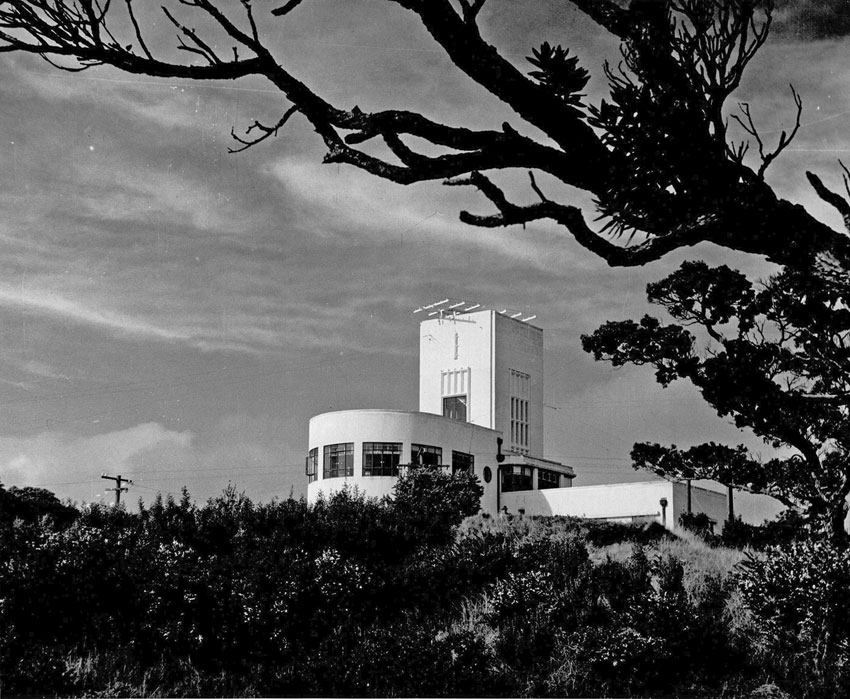
Photo: musickpointradio.org
This photo, probably from the 1940s, shows Musick Point, the receiving station for Auckland Radio ZLD.
QMX transceiver, the ultra-compact performer
One of our net members has amassed a serious collection of QRP Laps transceivers. After building the QMX+, he hankered for something smaller that would still offer multi-mode and multi-band operation. Thus a step back to the QMX (not Plus) model.
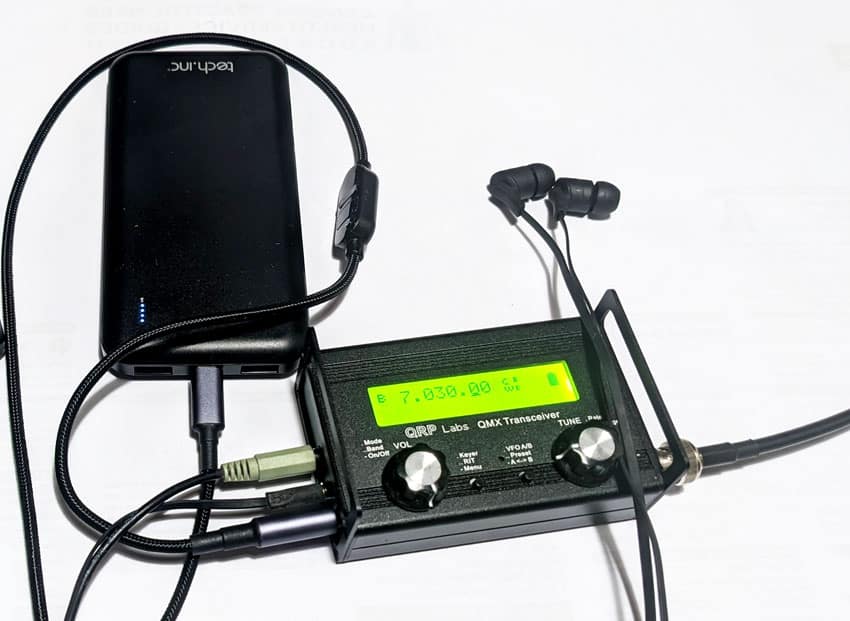
QMX transceiver with 9-volt battery. Photo: ZL1AJY
By Paul ZL1AJY
Here’s a pic of my QMX transceiver with 9 volt DC supply via fast-charge battery.
The cable has a small inverter which allows selection of output 5 / 9 / 12 / 15 volts DC. I built my QMX for 9-volt operation. This is simply the transformer turns ratio around the power stage.
RF output is about 4 watts on 80 and 40 metres and slightly lower on 30 and 20.
CW performance is very impressive. Smooth QSK or semi-QSK. Iambic A or B keyer. Memories. Dual VFO. 1hz resolution. Adjustable RX filter width.
AGC features are excellent; I am an AGC junkie from way back and the QMX has adjustable AGC slope and hang, which is uncommon on amateur hardware.
On SSB the AGC options make for easy relaxed listening. Transmitter operation, based on my own experience, is not quite top shelf. I have done quite a few tests and found that microphone levels are a large part of the story. The recommended electret element output is about 20dB higher than my various headsets. Adding a BC547 pre-amp has got things running but it’s a work in progress.
Post-build testing is automatic with a dummy load. A terminal can be connected via the USB C socket, all settings can be viewed and changed from a keyboard. In my case PuTTY on a Linux box.
Morse challenge
David ZL2WT is thinking of doing the next Straight Key Night from a location not too far from his home. But he thought it might be a challenge for other operators to copy his QTH. So here’s a practice run:
How did you do?
Your assignment is to send me a QTC (or email if you have no RF) with the answer to this question:
What is the name of the person who played the flute?
Video: CW operation with the IC-7300, part 2
Net tip: QRH
We continue our look at Q signals with QRH.
Years ago, this was heard a lot more than it is today. (Thank goodness!)
It means: “Your frequency varies.”
Conversely, QRH? means “Does my frequency vary?
The A-Z of Q Signals
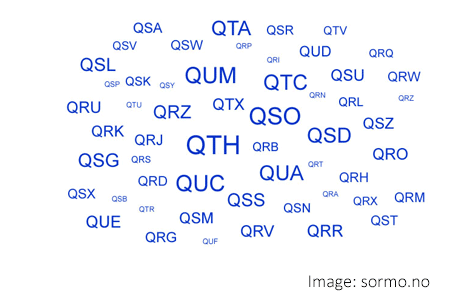
A well-run CW net is a lovely thing to experience. Communication between stations is quick and concise, and the net business is conducted with minimal time wasted.
As CW operators, we have many techniques to communicate quickly and efficiently. And if we know and use these techniques, we can often match or exceed the speed and accuracy of voice communication.
One of our most important tools is the set of Q Signals (or Q Codes), and in this series we look at the “essential” ones, in alphabetical order.
Advertising archive
This advertisement from 1938 is well worth reading for its historical references:
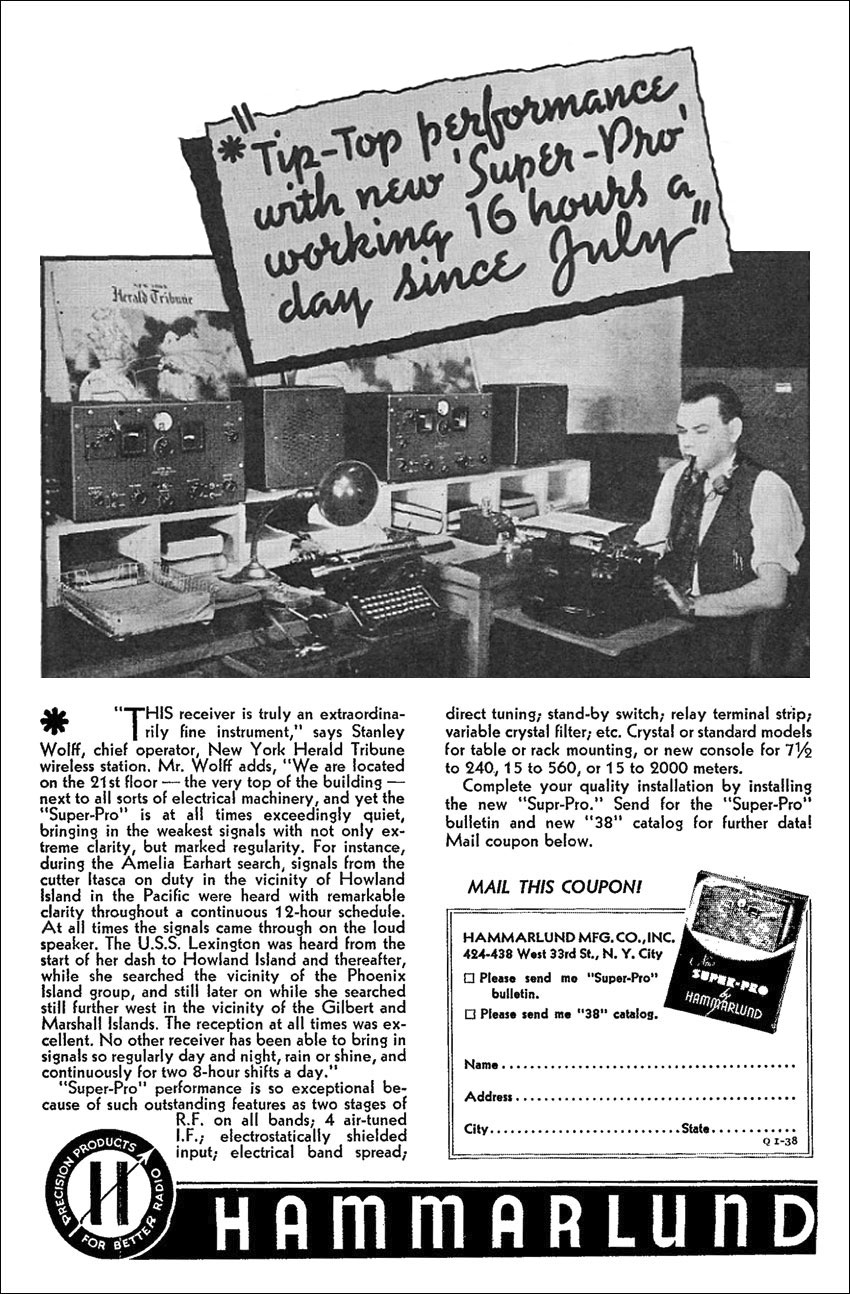
QST magazine, Jan 1938
Suggestions?
If you have suggestions on how to make the NZ Net better, or things you’d like to see covered in these newsletters, please contact ZL1NZ. Articles and photos will be gratefully received!
Thanks for reading, and I hope to hear you soon on the NZ Net!
—
Neil Sanderson ZL1NZ, Net Manager
New Zealand Net (NZ NET)


 Open the menu by clicking the “burger” icon at top right.
 Many menu items can be expanded to reveal subpages by clicking on the arrow. Click again to collapse the menu item.