
This is a free fortnightly newsletter about the New Zealand Net.
If you would like to be notified by email when a new edition is published, please subscribe here.
Browse our Newsletter Archive and List of Net Tips.
Featured key

Photo: ZL2AUA
This key was made by Mike ZL2AUA, and used for the first time during Straight Key Night on 7 December, the day after he finished making it.
The wood is teak, with an ebony button on the top of the knob. The metal is brass, with a tool-steel pivot pin running in self-lubricating brass bushes. There is a 10mm steel plate let into the bottom of the teak base to add some weight and hold everything in alignment.
“The main goal,” says Mike, “was to have fun making something beautiful and looking like it had a bit of history. The actual design evolved as work progressed, but basically I wanted brass and teak.
“The lever needs to be rigid but also light, as its mass will put a limit on how fast the thing can move. The lighter the lever, the faster the Morse can be. It started as a length of 20mm x 8mm brass flat bar. I wanted the knob to be as low as practicable, so the top of that end was milled down. The middle of the lever does not move very far or fast, so it could stay at (or near) 20mm in height, while the other end needed to have clearance for the spring, so the bottom of that end needed to be milled away accordingly. I also had to mill a little off the bottom of the middle, so the key would still clear the bottom of the slot in the trunnion when the key was depressed.
“If I had thought of it in time, I could have reduced the moving mass even more by making the gap adjuster at the far end of the lever part of the base, instead of being attached to the lever. Never mind, maybe next time. I am very far indeed from being a good CW op, and I can’t send very fast anyway. And as I can’t really copy Morse at much more than 15 words a week I shouldn’t try. 🙂
“There’s an interesting story behind the teak. Forty years ago, while I was living in England. I built a 40-foot (12m) ketch, and made the window frames from teak. A timber yard near my village had acquired some 2-inch (50mm) thick teak from the demolition of the London Harbour Board’s headquarters, which had been built, I think, around 1905. At that time Britain more-or-less owned Burma, so the massive doors for the lifts were made of Burmese teak. The base and knob of the new key are therefore leftovers from a yacht’s window frames made from genuine Burmese teak, milled at a time when Morse telegraphy was what enabled Britain to keep tabs on its empire.”
Quick notes
 David ZL2WT has noticed that many recently-registered vehicles in New Zealand have number plates that look like Q-Signals: “Down the road from our home are a QSL and a QRV – I am still looking for a QTH! I’ve got QNN, which would only be recognised by someone who is a member of a CW net. If I was assigned QSD, I think I would sell the car!”
You’re right David – a friend of mine has the number plate shown in this photo, and I am impressed!
Speaking of high-speed CW, here’s a funny short story, courtesy Jeff KE9V.
CQ XING. On 1 January, Japan’s A1 Club launched an on-air activity to help new CW operators get comfortable with “rubber-stamp QSOs” and ragchewing. Stations call CQ XING to signal that they are looking for more than “5NN TU” and that they will be happy to work newcomers. XING stations may be found on any band at any time, but in particular on Fridays, 1300-1500 UTC, around 7030 kHz. Details.
Back to the beginning. As we begin another year, here’s a reminder that most amateur radio traffic handlers start each year’s outgoing messages with NR1. Operators are free to use their own numbering system, of course.
Photo flashback

Here’s a delightful QSL card from cartoonist Otto Eppers (W2 “Easy Aces”) in 1948. What a joy it must have been to find one of these in your letterbox! This card was possibly the first use of the “new” QCWA logo too.
Net numbers
December was a busy month, with 20 stations checking into the NZ Net.
NR1 R ZL1NZ 51/48 AUCKLAND 0800Z 1JAN26
=
NZ NET
=
DEC QNI F5MUX 1 F6DCQ 1 N4OA 1 NO6M 1
PA9O 1 VK3DBD/ZL 1 VK3DRQ 22 VK4PN 12 ZL1AJY 3
ZL1ANY 27 ZL1BDS 24 ZL1NZ 26 ZL1PX 23 ZL2AEL 1
ZL2GD 17 ZL2KE 21 ZL2LN 12 ZL2TE 11 ZL4GW 21
ZL4KX 3 ZL4LDY 6 TOTAL 235 QTC 53
=
ZL1NZ

Annual summary
We had a record number of check-ins (2948) during 2025.

(2019 was an incomplete year, as NZ Net began on 25 March 2019)
Video
Net tip: QRA
We continue our look at Q signals with QRA.
It means: “The name (or callsign) of my vessel/station is … “
When sent with a question mark, QRA? means “What is the name (or callsign) of your vessel/station?”
You might use QRA? if you hear a station that you would like to contact, but you didn’t copy their callsign.
Note that this is rather different from the more common QRZ? in at least two ways:
- QRA? can be used even if the station is not calling you, and
- The only station that should reply to a QRA? is the station in question, whereas any station can respond to a QRZ?.
The A-Z of Q Signals
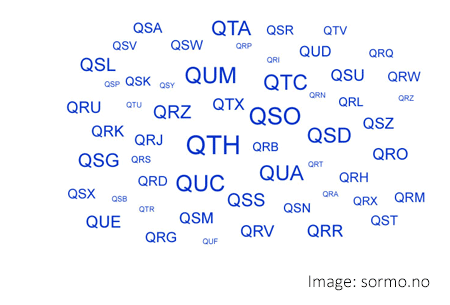
A well-run CW net is a lovely thing to experience. Communication between stations is quick and concise, and the net business is conducted with minimal time wasted.
As CW operators, we have many techniques to communicate quickly and efficiently. And if we know and use these techniques, we can often match or exceed the speed and accuracy of voice communication.
One of our most important tools is the set of Q Signals (or Q Codes), and in this series we look at the “essential” ones, in alphabetical order.
Advertising archive

The Voice-O-Graph recording booth was made by Mutoscope from 1940 to 1957 and could often be found at amusement arcades, fairgrounds and in shops. Audio was recorded onto laminated cardboard discs which could be played back on a standard record player. Neil Young even recorded an album on one!
Suggestions?
If you have suggestions on how to make the NZ Net better, or things you’d like to see covered in these newsletters, please contact ZL1NZ. Articles and photos will be gratefully received!
Thanks for reading, and I hope to hear you soon on the NZ Net!
—
Neil Sanderson ZL1NZ, Net Manager
New Zealand Net (NZ NET)


 Open the menu by clicking the “burger” icon at top right.
 Many menu items can be expanded to reveal subpages by clicking on the arrow. Click again to collapse the menu item.