
This is a free fortnightly newsletter about the New Zealand Net.
If you would like to be notified by email when a new edition is published, please subscribe here.
Browse our Newsletter Archive and List of Net Tips.
Featured key

Photo: Jason Alex in Morse Keys group on Facebook
CT keys, including the CT Asia model seen above, were made in Ukraine by UT7CT.
Quick notes
 We survived the CQWW contest! Last weekend was one of the biggest CW contests of the year, and I was nervous about whether we’d be able run the net on 40 metres, given the expected deluge of big signals. But things went well. On Saturday evening, 7030 was occupied at net time so we moved to 7030.250 and the net ran smoothly, with traffic passed up 5 kHz as well. On Sunday, we were able to stay on 7030, again with good copy. Thank you to our adaptable net operators, and to the contesters who stayed clear of us for the duration of the net.
Graeme ZL2TE has been amusing us each Monday with an original limerick about an NZ Net member. One of his recent efforts appears below, in the SKN article. I hope Graeme continues writing these, as he’s got a talent for poetry (and a good supply of characters among the NZ Net members). 🙂
A new billion-dollar-plus system to better ensure cellphones get through in emergencies is being opened up to community groups in New Zealand. About 25,000 frontline responders are already using the Public Safety Network’s cellular service, which extends coverage and gives extra back-up. The government has now opened the service to central and local government entities, not-for-profit organisations, and infrastructure and lifelines companies. Continue reading at RNZ.
The European CW Group is running a traffic net on 3554 kHz at 2000 Wednesday UTC.
I still know Morse at 100, says codebreaker. During World War Two, Cynthia Evans was stationed at Chicksands Priory, near Shefford, Bedfordshire, and spent her days relaying messages to the Bletchley Park codebreaking hub. Continue reading at BBC.
Photo flashback

Photo: Ryerson University Archives
Two young men are seen practising Morse Code receiving using an Instructograph machine at the RyeHam Amateur Radio Club (VE3RIT), which was founded in 1953 at Ryerson Institute of Technology (now known as Toronto Metropolitan University).
SKN this weekend
NOTE: SKN begins at the same time as NZ Net, so the net will be an abbreviated affair. Please hold any non-urgent traffic for a later net session.
 New Zealand Straight Key Night (Summer Edition) will be held on Sunday 7 December from 9pm to 10pm NZT (0800 to 0900 UTC) on 80 metres.
SKN honours the original amateur radio mode in an easy-going style. Operators send signal report, name, location, type of key, type of transmitter and power output. Stations are limited to 100W output power.
SKN is not a contest – but the operator who gets the most votes for the quality of their sending will win the Bruce Scahill Best Fist Award. Please email your award nomination to ZL1NZ within one week following the event.
SKN uses the QSY Rule. Any station that calls CQ must QSY after making a contact.
Full details about SKN are available at zl1.nz/skn.
SKN welcomes all straight key operators, regardless of skill level or speed.
And now, a few words from our poet:
NR13 R ZL2TE 34/3Ø NEW PLYMOUTH Ø715Z 20NOV25
=
NZ NET HUMOUR
=
THERE WAS A STRAIGHT KEYER NAMED GRANT
WHOSE FIST WAS AS SMOOTH AS YOU WANT
HIS TIMING PRECISE
HIS SENDING SO NICE
AND HE BAGGED BEST FIST NOW TO FLAUNT
=
ZL2TE
ARL numbered messages
 This is a good time of year to make use of ARL numbered messages in your radiograms. There are two such messages that may be especially useful:
ARL SIXTY ONE = “Wishing you a very Merry Christmas and a Happy New Year”
ARL SIXTY TWO = “Greetings and best wishes to you for a pleasant _____ holiday season”
Don’t forget to include “ARL” just before the check numbers in your message preamble. And if you receive an ARL message for delivery, please replace the ARL code with the full text.
On the Resources page, you’ll find a handy list of the most frequently used routine ARL messages, plus the full list which includes welfare and emergency messages.
Holiday season opportunity for 3rd party messages
Can you guess how many pieces of formal traffic have been handled via NZ Net in our six-year history?
The answer is just a little over 3000.
Virtually all of these messages have been amateur-to-amateur, rather than 3rd party traffic, i.e. messages sent from or to non-amateurs. There are good reasons for that:
- Although sending or receiving a message by Morse Code via an amateur radio traffic net is free – that holds little appeal for the average person in an era when everyone has email and a phone with a cheap calling plan.
- As a small net, we do not have operators in every hamlet gathering and delivering messages on behalf of their community.
- Delivering messages by telephone may be difficult these days, since many people say they don’t answer calls from numbers they don’t recognise.
 So, generating 3rd party traffic for the net is a challenge, but maybe not hopeless. And the holiday season is a great time to give it a try, as James WB8SIW explains in an excellent blog post at radiorelay.org.
The easiest way to get some 3rd party traffic started is for net members to originate messages to their non-amateur family and friends elsewhere in the country. These are then sent on the net to the nearest operator who has indicated their willingness to receive 3rd party traffic. (Soliciting messages to send on behalf of non-amateurs is harder, but can be done at public events where amateur radio is being demonstrated, so that’s probably best left for another day.)
I’m happy to accept 3rd party traffic for delivery in Auckland. Delivery would be via telephone, email or even to the letterbox if it’s not too far away.
Anyone else want to volunteer to deliver messages in their community?
For hard-copy delivery or email delivery, we have a “Happy Holidays” radiogram form available for download on the Resources page. It includes explanatory information about the radiogram service.
Net numbers

NR45 R ZL1NZ 39/36 AUCKLAND Ø8ØØZ 1DEC25
=
NZ NET
=
NOV QNI VK3DRQ 28 VK4PN 14 W7XP 1 ZL1AJY 2
ZL1ANY 29 ZL1BDS 16 ZL1NZ 29 ZL1PX 2Ø ZL2GD 7
ZL2KE 15 ZL2LN 13 ZL2TE 11 ZL4GW 14 ZL4KX 4
ZL4LDY 1Ø TOTAL 213 QTC 55
=
ZL1NZ
Video: Andrew W0AAA on a single-lever paddle by N3ZN
This video was recorded in 2009. The keying speed is 60 wpm, but with extended spacing.
Net tip: QNQ
We continue our look at Q signals with QNQ.
I delayed presenting this one until we had covered QNY in the previous NZ Net News, because QNQ only applies if we already have a QNY situation occurring.
You’ll recall that QNY means “Shift to another frequency, or to … kHz, to clear traffic with … “
QNQ means: “Move frequency to … and wait for … to finish handling traffic. Then send him traffic for … “
Here’s an example:
Net Control sends: ZL2KE QNY U5 ZL4GW (“2KE and 4GW go up 5 kHz and clear traffic”)
Then ZL1BDS checks in with traffic for ZL2KE.
Net Control sends this to 1BDS: QNQ U5 ZL2KE (“go up 5 kHz and wait for 2KE”)
ZL1BDS will QSY immediately and then will need to jump in fast as soon as he hears 2KE and 4GW finish their traffic, in order to catch 2KE before he returns to net frequency. ZL1BDS will send something like: “ZL2KE DE ZL1BDS QTC1 QRV?”
Net Control has discretion over whether or not to send QNQ, as we don’t want too many stations waiting off-frequency, as this could delay the completion of the net.
The A-Z of Q Signals
A well-run CW net is a lovely thing to experience. Communication between stations is quick and concise, and the net business is conducted with minimal time wasted.
As CW operators, we have many techniques to communicate quickly and efficiently. And if we know and use these techniques, we can often match or exceed the speed and accuracy of voice communication.
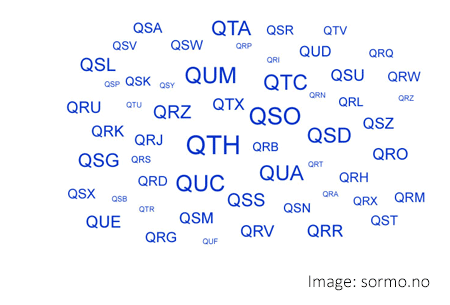
One of our most important tools is the set of Q Signals (or Q Codes), and in this series we look at the “essential” ones, in alphabetical order.
Advertising archive

From the late 1950s. The OM is very tidy; he keeps his Vibroplex in a drawer when he’s not on the air. 🙂
Suggestions?
If you have suggestions on how to make the NZ Net better, or things you’d like to see covered in these newsletters, please contact ZL1NZ. Articles and photos will be gratefully received!
Thanks for reading, and I hope to hear you soon on the NZ Net!
—
Neil Sanderson ZL1NZ, Net Manager
New Zealand Net (NZ NET)


 Open the menu by clicking the “burger” icon at top right.
 Many menu items can be expanded to reveal subpages by clicking on the arrow. Click again to collapse the menu item.