
This is a free fortnightly newsletter about the New Zealand Net.
If you would like to be notified by email when a new edition is published, please subscribe here.
Browse our Newsletter Archive and List of Net Tips.
Featured key
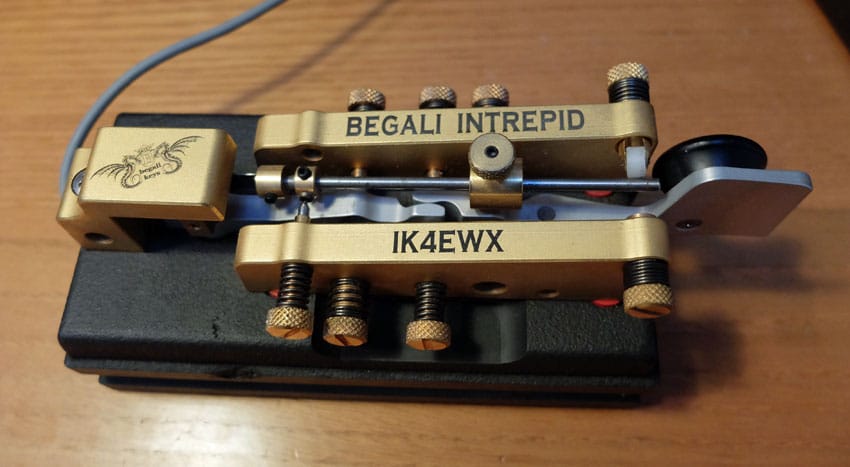
Begali Intrepid. Photo: IK4EWX
By Ian IK4EWX
If there’s a truly new bug design, after the Mecograph system (and other bugs with L-shaped pendulums and tension releases like the Australian Simplex Auto) and the Vibroplex system, it’s unquestionably the Begali Intrepid (photo above).
With its split lever and overlapping pendulum, the Intrepid gives the operator total, easy control of the bug. The Intrepid allows for hours of telegraphic manipulation, error-free and effortless. It’s a heavy bug (2.2 kg) which doesn’t move on the table.
It’s certainly the easiest bug to use, ideal for beginners at 16 wpm as well as experienced operators at 25-34 wpm.
A special version of the Intrepid exists. The Begali Sculpture Galaxy is the 100% stainless steel version (photo below).
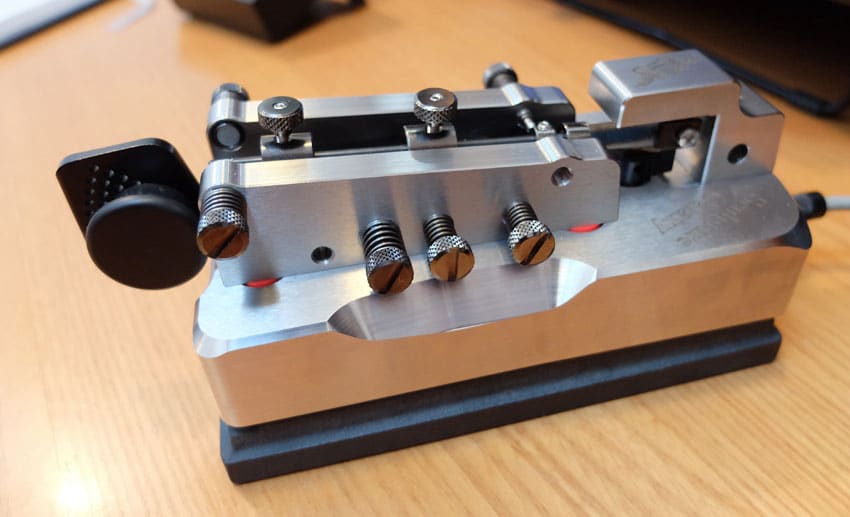
Begali Sculpture Galaxy. Photo: IK4EWX
Weighing 2.8 kg, its unique style, perhaps due to the heavier base, gives the Sculpture Galaxy an even more solid feel than the Intrepid.

Piero Begali (left) and Ian IK4EWX in the Begali factory
Piero Begali has also created a special add-on base that allows both the Intrepid and Galaxy to operate with the paddle at a height of 5 cm from the table, as recommended by the great Ted McElroy. The add-on base can be see in the photo of the Sculpture Galaxy.
Today, there are operators, like myself, who use all their bugs “in elevation”: this allows for freer rotation of the wrist, the type of manipulation suggested by David N1EA David for error-free operation (see his movies on YouTube), even at high speeds, and reducing movement fatigue.
Quick notes
 Too many good fists. Straight Key Night on 7 December attracted 13 operators for an hour of fun on 80 metres. There was no clear winner of the Bruce Scahill Best Fist Award, due to a 5-way tie in the votes. So congratulations to all the nominees: ZL1NZ, ZL2GD, ZL2LN, ZL3TK and ZL3VZ. I suspect a couple others would have been in the running, except they were using very low power and not heard by everyone. 🙂
Chris VK3QB is the new editor of the FISTS Downunder newsletter and is also going to be running CW Academy courses for Beginner, Intermediate and Advanced operators in January and February. Contact Chris for more info.
SAQ Christmas transmission: On 1 December 1924, the 200kW Alexanderson alternator with callsign SAQ was put into commercial operation with telegram traffic from Sweden to the United States. 101 years later, the transmitter is the only remaining electro-mechanical transmitter from this era and is still in running condition. On Christmas Eve morning, Wednesday 24 December 2025, the transmitter is scheduled to spread the traditional Christmas message on 17.2 kHz CW.
Photo flashback
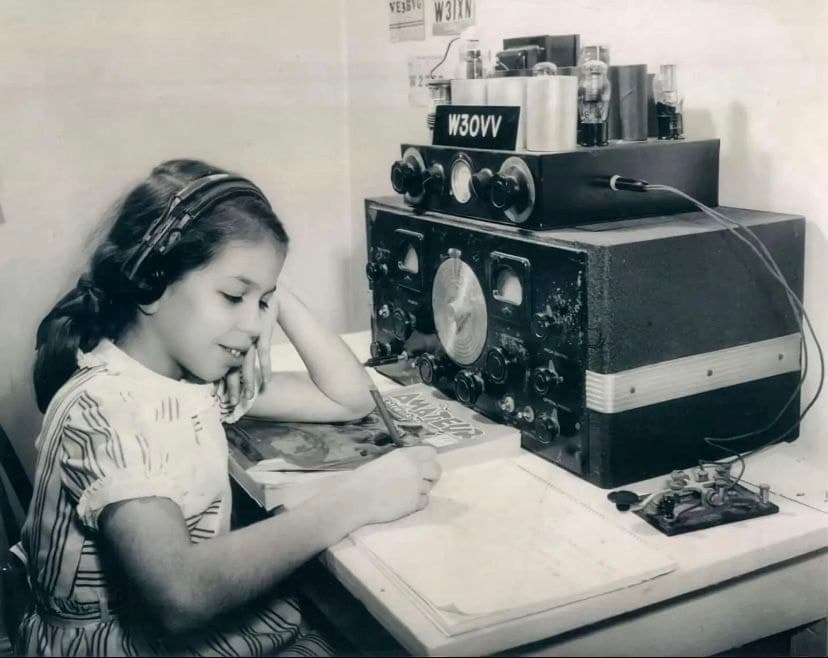
Jane Bieberman W3OVV achieved her amateur radio licence at age 10 in 1948 (when this photo was taken), no doubt influenced by her father Jesse W3KT, a long-time amateur. Jane died in 2025.
Repairs almost complete at weather radar site
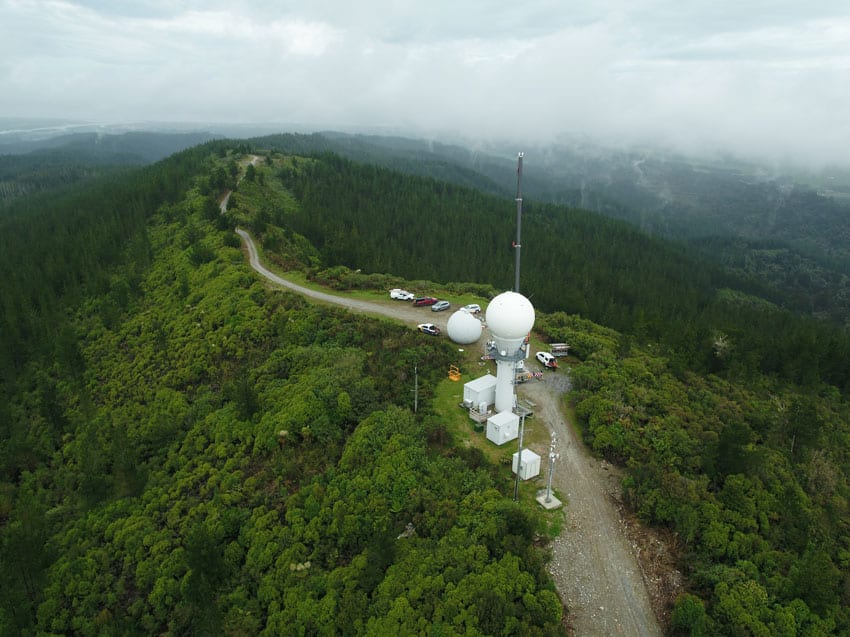
Drone photo: Coastwide Films
The Westland weather radar has taken a major step towards full service after being struck by lightning on 18 September. Last Saturday, four radar technicians successfully removed the damaged fibreglass radome and installed a new one (both can be seen in the photo). There are still a few technical issues to resolve from the lightning strike, but MetService says the radar should be back to full operation before the Christmas break.
Methods of wireless telegraphy in 1938
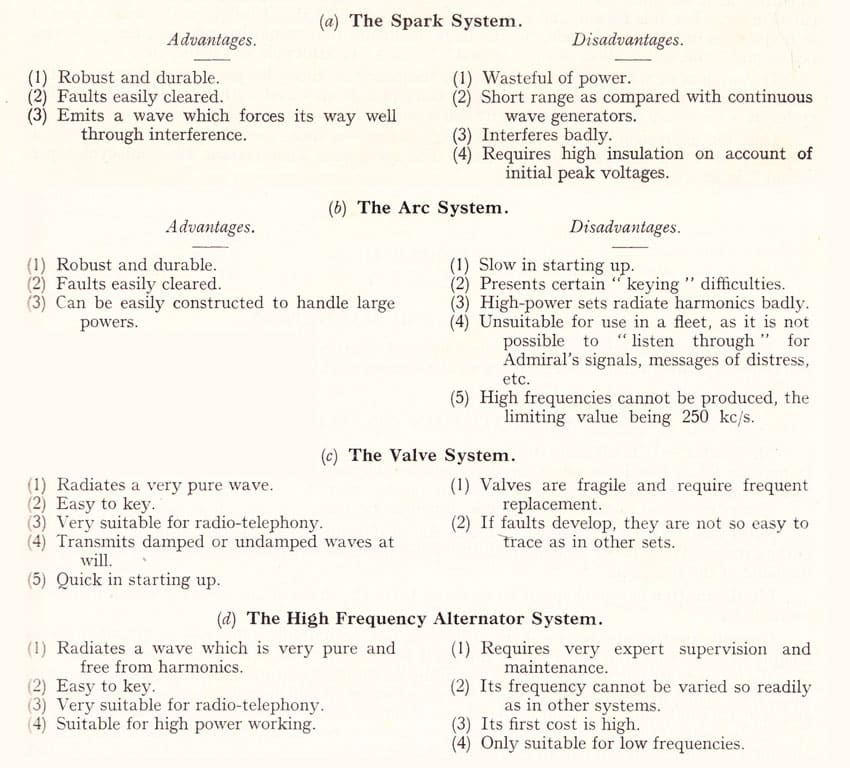
From BR 229: Admiralty Handbook of Wireless Telegraphy – Vol 1, 1938
Video: JRC twins
Lee F5MUX checked into the NZ Net a few days ago. Take a look at his lovely JRC station:
Net tip: QNZ
We continue our look at Q signals with QNZ.
It means: “Zero beat your signal with mine.”
Net Control sends it at the start of each net to remind all stations to zero beat net control.
It’s a useful reminder, I think.
Although zero beating has been a basic and essential skill of the radio amateur since the advent of VFOs a very long time ago, we can think sometimes that we’re on frequency when we’re not. For example:
- Is my RIT or XIT switched on?
- Am I in split-frequency mode? (There have been a few times when I wondered why my antenna was showing extremely high SWR as I tuned up. Then I realised my last contact had been working split on a different band, and the rig was still trying to transmit there using the wrong antenna!)
Please remember that net frequency is the frequency on which Net Control is operating. It may not always be the advertised frequency, so please zero beat carefully, or you may hear Net Control request that you QNZ. 🙂
And if you’re using an old rig, you may need to touch up the frequency occasionally during the net, due to drift.
The A-Z of Q Signals

A well-run CW net is a lovely thing to experience. Communication between stations is quick and concise, and the net business is conducted with minimal time wasted.
As CW operators, we have many techniques to communicate quickly and efficiently. And if we know and use these techniques, we can often match or exceed the speed and accuracy of voice communication.
One of our most important tools is the set of Q Signals (or Q Codes), and in this series we look at the “essential” ones, in alphabetical order.
Advertising archive
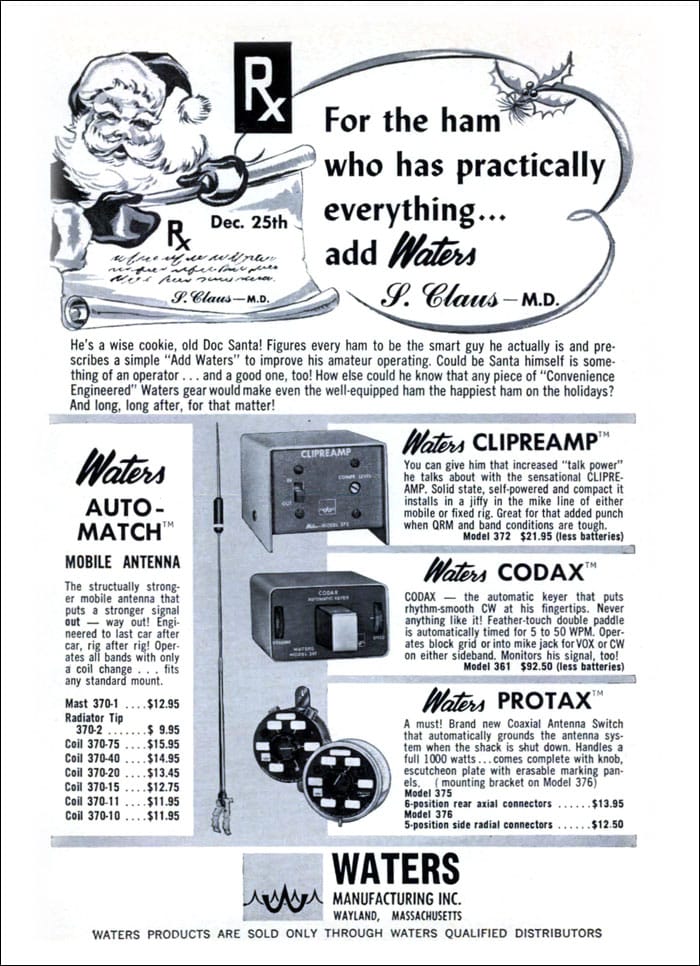
Suggestions?
If you have suggestions on how to make the NZ Net better, or things you’d like to see covered in these newsletters, please contact ZL1NZ. Articles and photos will be gratefully received!
Thanks for reading, and I hope to hear you soon on the NZ Net!
—
Neil Sanderson ZL1NZ, Net Manager
New Zealand Net (NZ NET)


 Open the menu by clicking the “burger” icon at top right.
 Many menu items can be expanded to reveal subpages by clicking on the arrow. Click again to collapse the menu item.